
Two Tools, One Job — But Not Interchangeable
Walk into any gun store and you'll find two categories of lights marketed to defensive shooters: weapon-mounted lights that attach directly to the pistol's accessory rail, and handheld tactical flashlights designed to be carried separately. Both produce light. Both are marketed to the same buyers. And both have passionate advocates who insist their preferred option is the correct choice.
The debate is real, but it's often framed incorrectly. The question isn't "weapon light or flashlight" — it's "what does each tool do, when does each excel, and what are the genuine trade-offs?" Understanding the functional differences between a weapon-mounted light and a handheld flashlight will help you build a lighting system that actually serves your defensive needs rather than one that sounds good in theory but fails in practice.
This guide covers the mechanical and functional differences between weapon lights and handheld flashlights, the specific advantages and limitations of each, the scenarios where each performs best, and how to think about building a complete low-light defensive system. WARRIORLAND's weapon light lineup is referenced throughout for practical product context.
What Makes a Weapon Light Different from a Tactical Flashlight
The Fundamental Design Difference
A weapon-mounted light is engineered specifically to attach to a firearm's accessory rail and function as part of the shooting system. A handheld tactical flashlight is engineered to be carried and operated independently of any firearm. These different design objectives produce tools with meaningfully different characteristics — even when both produce similar lumen outputs.
Weapon-mounted lights are optimized for:
- Secure, vibration-resistant attachment to a rail under recoil
- Activation without breaking the firing grip — switches positioned for support-hand thumb or index finger access
- Compact form factor that doesn't significantly change the pistol's handling characteristics
- Durability under the mechanical stress of repeated firing
- Compatibility with light-bearing holsters for carry
Handheld tactical flashlights are optimized for:
- Ergonomic one-hand operation as a standalone tool
- Versatile use across many contexts — searching, signaling, navigation, utility
- Tail-cap or side-switch activation designed for single-hand use
- Higher output options (some handheld lights exceed 1,000+ lumens) without rail-mount constraints
- Carry in a pocket, pouch, or bag without requiring a firearm
Output and Beam Pattern
Both weapon lights and handheld flashlights are available across a wide range of lumen outputs. For defensive use, the relevant range is roughly 150–1,000+ lumens. Within this range, the differences in output between weapon lights and handheld lights are less significant than the differences in how that output is delivered.
Weapon lights typically produce a tighter, more focused beam optimized for target identification at defensive distances (0–25 yards). The beam is designed to illuminate the threat area directly in front of the muzzle — the area the pistol is pointed at. This focused beam maximizes the disorientation effect on an adversary and provides clear target identification in the shooting zone.
Handheld flashlights often produce broader beams with more spill light, which is useful for general illumination, searching, and navigation but may be less effective for the focused target identification that weapon lights are designed for. Some handheld lights offer adjustable beam focus; most weapon lights do not, because the focused beam is a feature rather than a limitation for their intended use.
Recoil Resistance
A weapon-mounted light must survive the mechanical shock of repeated firing. Every shot produces a sharp recoil impulse that would damage or dislodge a light not designed for it. Quality weapon lights are built with recoil-resistant construction — reinforced housings, secure rail attachment systems, and internal components that can withstand thousands of firing cycles without failure.
Handheld flashlights are not designed for this environment. A handheld flashlight attached to a pistol rail with an improvised adapter — a setup sometimes seen at ranges — may survive a few shots but is not a reliable defensive solution. The light may shift, loosen, or fail under sustained fire. Weapon lights are purpose-built for this environment; handheld lights are not.
The Core Functional Difference: Hands-Free Operation
Why This Matters More Than Anything Else
The most important functional difference between a weapon-mounted light and a handheld flashlight is not output, beam pattern, or durability — it's whether the light requires a hand to operate.
A weapon-mounted light is activated by a switch accessible to the support hand while maintaining a two-handed firing grip. Once activated, it illuminates the target area without requiring either hand to hold it. Both hands remain on the pistol, providing the stable, accurate shooting platform that defensive shooting demands.
A handheld flashlight requires one hand to hold and operate it. When the flashlight is in the support hand, the shooter has two options: use a two-handed flashlight technique (Harries, Rogers/SureFire, FBI modified) that attempts to stabilize the pistol while holding the light, or shoot one-handed while the support hand holds the light. Neither option provides the stability and control of a two-handed firing grip with a weapon-mounted light.
This hands-free advantage is the primary reason weapon-mounted lights are preferred by law enforcement, military, and serious defensive shooters. When the moment comes to fire, you want both hands on the pistol — not one hand on the pistol and one hand on a flashlight.
The Two-Handed Flashlight Techniques: What They Are and What They Cost
Experienced shooters have developed several techniques for using a handheld flashlight with a pistol:
Harries Technique: The flashlight is held in the support hand with the back of the hands pressed together, providing some stability. The technique works but produces a less stable platform than a two-handed grip and requires significant practice to execute reliably under stress.
Rogers/SureFire Technique: The flashlight is held between the index and middle fingers of the support hand, with the remaining fingers wrapping around the pistol grip. This technique allows a more normal grip but requires a specific flashlight size and significant training.
FBI Modified Technique: The flashlight is held away from the body in the support hand, with the pistol in the strong hand. The light is held to the side to separate the light source from the shooter's position. This technique is specifically designed to address the position-reveal concern but sacrifices stability and accuracy.
All of these techniques work. All of them require dedicated training to execute reliably under stress. And all of them produce a less stable shooting platform than a two-handed grip with a weapon-mounted light. The techniques exist because handheld flashlights have real utility — but they exist as workarounds for the fundamental limitation of needing a hand to hold the light.
Where Each Tool Excels
The Weapon-Mounted Light's Strongest Use Cases
The moment of threat identification and response: When a threat has been identified and the pistol is being deployed, the weapon-mounted light is unambiguously superior. Both hands are on the pistol, the light illuminates exactly where the muzzle is pointed, and the shooter can focus entirely on the threat and the shooting task. This is the scenario that defensive carry is designed for, and the weapon-mounted light is optimized for it.
Home defense: In a home invasion scenario, the defender is moving through their own space, potentially encountering threats at close range, and needs to identify targets quickly and accurately. The weapon-mounted light provides hands-free illumination that allows the defender to maintain a two-handed grip while identifying and responding to threats. The light is always available — it doesn't need to be retrieved from a pocket or pouch.
Consistent carry: A weapon-mounted light is always with the pistol. There's no separate item to remember, no additional carry burden, and no scenario where the pistol is available but the light isn't. For defensive carry, this consistency is a meaningful practical advantage.
Disorientation effect: A high-output weapon light — 800 lumens or more — directed at an adversary's face provides a significant disorientation effect that a handheld light held to the side (as in the FBI technique) does not. The weapon light's beam is directed exactly where the muzzle is pointed, maximizing the disorientation effect on the threat.
The Handheld Flashlight's Strongest Use Cases
Searching and investigating: When you hear a noise and need to investigate, you should not be pointing your pistol at every shadow you illuminate. A handheld flashlight allows you to search and illuminate without muzzling everything in your path. This is the handheld light's most important advantage over a weapon-mounted light for defensive use.
Non-threatening illumination: A weapon-mounted light cannot be used without pointing the pistol at whatever you're illuminating. This creates a serious problem in any situation where you need light but don't have a confirmed threat — illuminating a family member, a neighbor, or a pet with a weapon-mounted light means pointing a loaded pistol at them. A handheld flashlight provides illumination without this risk.
Everyday utility: A handheld flashlight is useful in countless non-defensive contexts: finding your keys in a dark parking lot, reading a menu in a dim restaurant, navigating a power outage. A weapon-mounted light is only useful when the pistol is drawn. For everyday utility, the handheld light is the practical choice.
Availability without the pistol: A handheld flashlight can be carried in contexts where a pistol cannot — in jurisdictions with carry restrictions, in gun-free zones, or in situations where carrying a pistol isn't practical. The handheld light provides illumination capability regardless of whether the pistol is present.
Position separation (FBI technique): In the specific scenario where an adversary is at distance and actively searching for the light source, holding the flashlight away from the body separates the light source from the shooter's position. This is the one scenario where the handheld light's position-separation capability provides a genuine tactical advantage over a weapon-mounted light.
The Micro-Pistol Problem: When There's No Rail
Subcompact and Micro-Compact Pistols Without Rails
The weapon-mounted light vs handheld flashlight debate takes on a different dimension for carriers of subcompact and micro-compact pistols that lack accessory rails. The Glock 42, 43, 43X, and 48 are the most common examples — extremely popular carry pistols that have no rail for a standard weapon light to attach to.
For these platforms, the traditional weapon-mounted light is not an option. Carriers of rail-less pistols face a genuine choice: carry a handheld flashlight as a separate item, upgrade to a rail-equipped pistol, or use a trigger-mounted light that attaches to the trigger guard rather than a rail.
Trigger-mounted lights represent a practical middle ground for rail-less carry pistols. They provide weapon-mounted light capability — hands-free operation, consistent availability with the pistol, activation without breaking the grip — at lower output levels than rail-mounted alternatives. They're not a perfect substitute for a full rail-mounted weapon light, but they provide meaningful capability for platforms that would otherwise have none.
For carriers of rail-less subcompact pistols who want weapon-light capability, the WARRIORLAND SLL-105 Trigger-Mounted Light/Laser for Glock 42/43/43X/48 provides 150-lumen white LED output with a red laser in a trigger-guard-mounted package. The SLL-105 with IWB Holster for Glock 43/43X provides the complete light-equipped carry solution including a platform-specific holster.
The Honest Answer: You Need Both
Why the "Either/Or" Framing Is Wrong
The weapon light vs handheld flashlight debate is often framed as a choice — as if you must pick one and carry only that. This framing is incorrect. The two tools serve different functions, and the complete defensive lighting system includes both.
The weapon-mounted light handles the moment of threat identification and response — when the pistol is drawn and both hands need to be on it. The handheld flashlight handles everything else: searching, investigating, non-threatening illumination, everyday utility, and the specific scenarios where position separation is tactically relevant.
Experienced defensive instructors consistently recommend carrying both. The weapon-mounted light is not a replacement for a handheld flashlight; it's a complement to it. The handheld flashlight is not a replacement for a weapon-mounted light; it's a complement to it. Together, they provide complete low-light capability that neither provides alone.
The Practical Carry System
For most defensive carriers, the practical implementation looks like this:
- Weapon-mounted light on the pistol: Always present, always available when the pistol is drawn, provides hands-free illumination during threat response
- Handheld flashlight in a pocket or pouch: Available for searching, investigating, non-threatening illumination, and everyday utility without drawing the pistol
- Training with both: Practice drawing the pistol with the weapon light, activating the light during the draw stroke, and re-holstering with the light attached. Practice handheld flashlight techniques for searching and investigating. Practice transitioning between the two tools.
Choosing a Weapon Light: Key Specifications
Output: The Lumen Question
For defensive use, 500 lumens is a practical minimum for indoor environments. 800+ lumens provides the disorientation effect that is one of the weapon light's key defensive advantages — the sudden transition from darkness to intense light that temporarily impairs the adversary's vision and decision-making. More lumens is generally better for defensive use, with the practical limits being battery life and heat generation.
For micro-pistol trigger-mounted lights, 150 lumens is the typical output — lower than rail-mounted alternatives but still meaningful for close-range defensive use.
Activation: Switch Placement and Modes
The activation switch must be accessible without breaking the firing grip. Most quality weapon lights position the switch where it can be reached by the support hand thumb or index finger during normal two-handed shooting. Momentary-on (light is on only while the button is pressed) and constant-on (light stays on after a single press) modes are both useful — momentary-on for intermittent use, constant-on for sustained illumination.
Battery Management
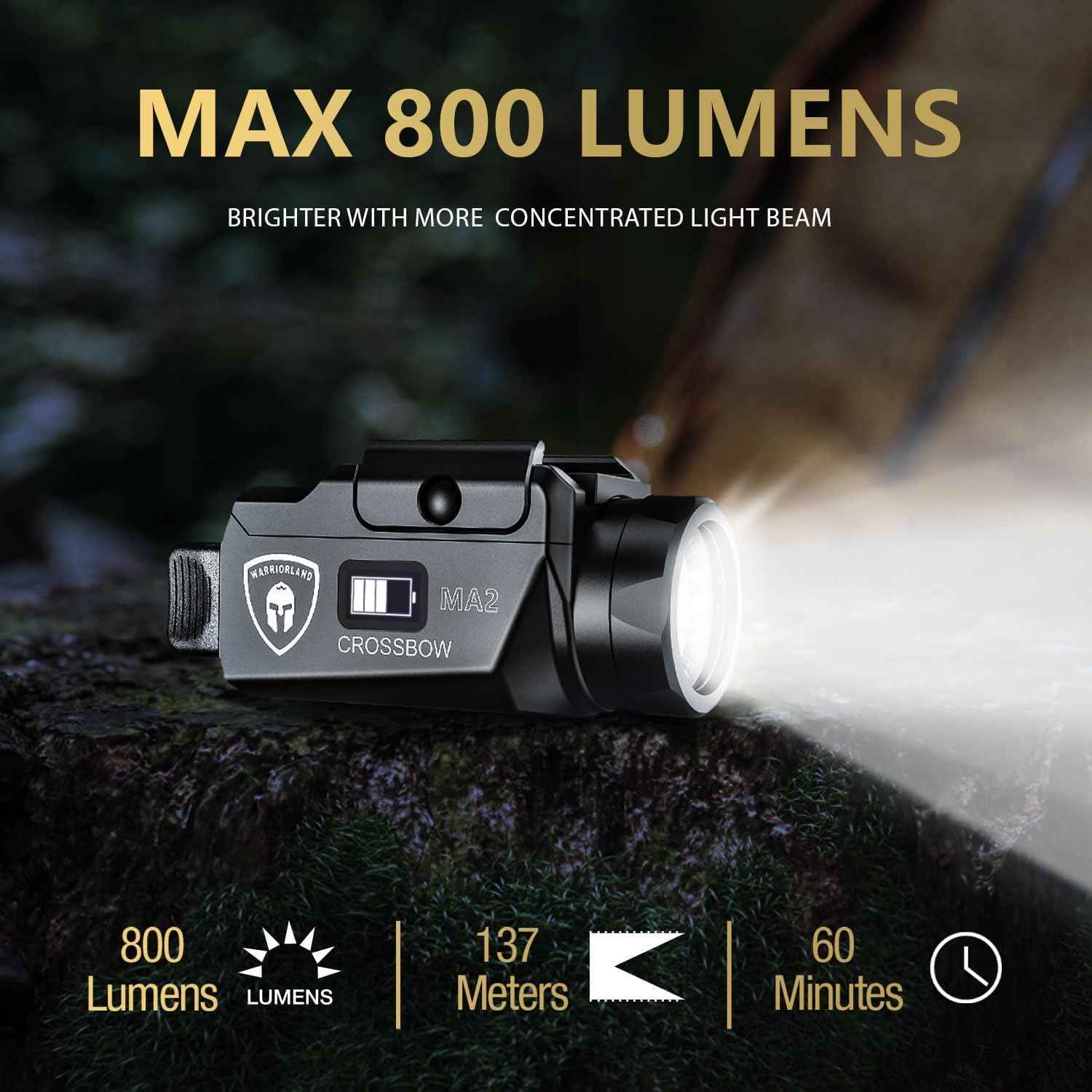
A weapon light with a dead battery is useless. Battery management — knowing the remaining charge before a carry session — is a practical concern that quality weapon lights address with battery status indicators. WARRIORLAND's MA2 series includes a screen-displayed battery status indicator that eliminates the guesswork of not knowing remaining charge.
Holster Compatibility
A weapon-mounted light changes the pistol's dimensions, requiring a light-bearing holster designed for the specific pistol-plus-light combination. This is a non-negotiable requirement — a standard holster will not accommodate the light, and attempting to carry a light-equipped pistol in a standard holster is unsafe. Platform-specific light-bearing holsters are the correct solution.
WARRIORLAND Weapon Light Lineup
Rail-Mounted: Full-Power Defensive Illumination
- WARRIORLAND MA2 Compact Pistol Light — Universal Rail Mount, 800 Lumens, Fits 60+ Handguns — The universal rail-mounted weapon light for carriers who want 800-lumen output across a broad range of compatible pistols. Screen power indicator, magnetic USB recharging. Compatible with Glock 17/19, P365, Taurus G3C/G2C, M&P 9, Hellcat Pro, 1911, and 60+ additional handguns.
- MA2 Pistol Light with Holster — S&W M&P Shield 9mm EZ — 800-lumen weapon light with platform-specific IWB holster. The complete light-equipped carry solution for M&P Shield EZ carriers who want weapon light capability without sourcing a separate holster.
- MA2 Pistol Light with Holster — Glock 20/21/22/23 Gen3-5 & Glock 34 Gen4 — 800-lumen weapon light with IWB holster for the larger Glock frame platforms.
- MA2 Pistol Light with Holster — Springfield Hellcat Pro — 800-lumen weapon light with IWB holster. Complete light-equipped carry solution for Hellcat Pro carriers.
Rail-Mounted Light + Laser Combo
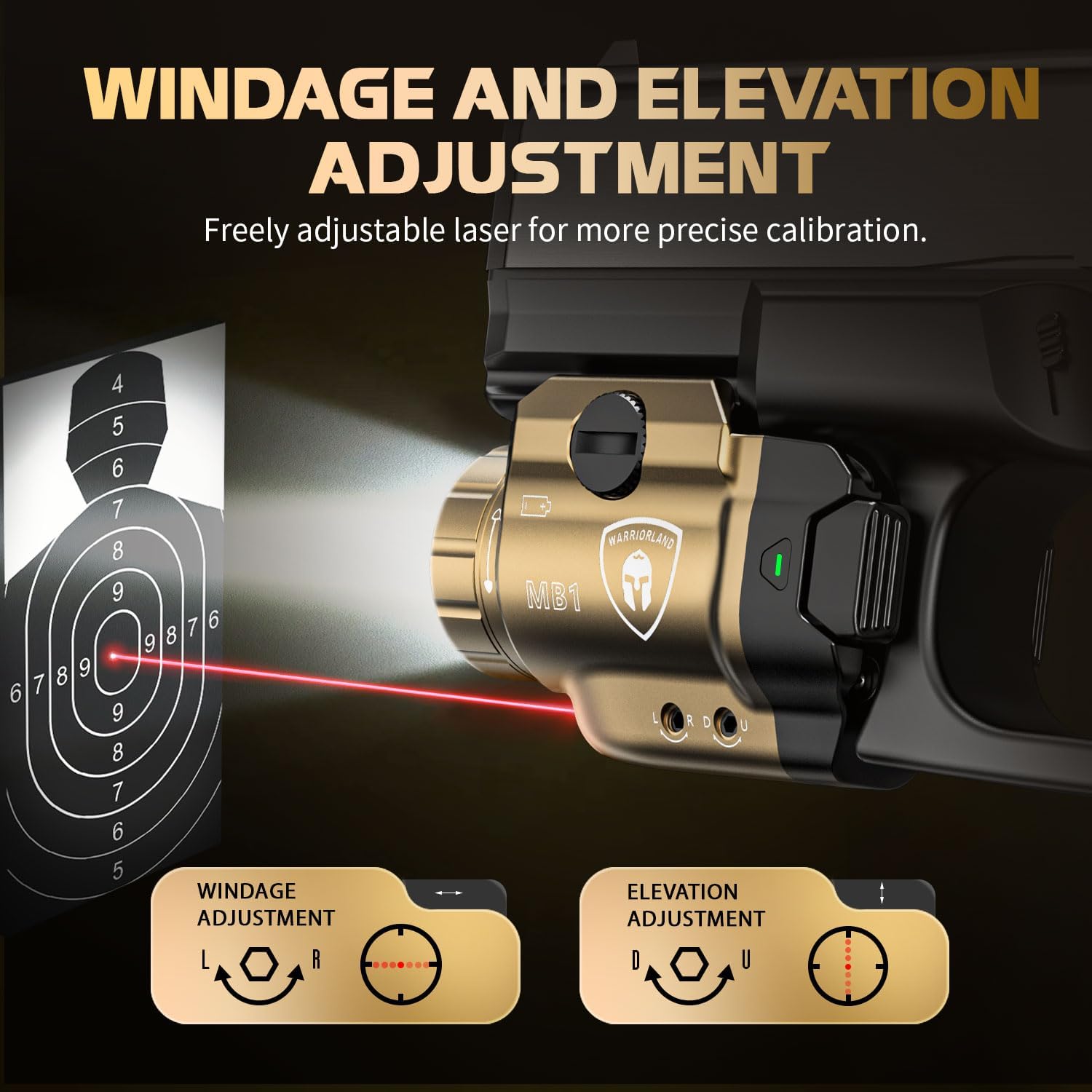
- WARRIORLAND MA1 — 800 Lumens, Green Laser & White LED, Universal Rail Mount — Combines 800-lumen white LED output with a green laser aiming device. Three working modes, built-in battery status screen, magnetic USB recharging. Universal rail mount for most full-size and compact pistols.
- MA1 Light/Laser Combo with Glock 17/19 Kydex Holster — Green laser and white LED with platform-specific Glock 17/19 holster. Complete light-and-laser carry solution for the most popular Glock platforms.
- MA1 Laser Light Combo with OWB Holster — Glock 17/19 Gen3-5, G22/23/31/32 Gen3-4, G19X/44/45 — 800-lumen LED and green laser with OWB holster. The OWB light-and-laser solution for Glock platform carriers who prefer outside-the-waistband carry.
OWB Light-Bearing Holster
- Glock 17/19/19X/45 Gen3-5 OWB Light-Bearing Holster — TLR-7A / TLR-7X / TLR-7 HL-X / TLR-8A / TLR-8X — Precision-fit OWB Kydex for Glock platforms with Streamlight TLR-7/8 series lights. Thumb release active retention, optic cut, 2.0" mid-ride belt loop.
- IWB Kydex Holster for Hellcat Pro OSP with TLR-7X Sub or TLR-7 HL-X Sub — Light-bearing IWB holster for the Hellcat Pro with Streamlight TLR-7 sub-compact lights. Optic cut, adjustable cant and posi-click retention.
Trigger-Mounted: Weapon Light for No-Rail Pistols
- SLL-105 Trigger-Mounted Light/Laser — Glock 42/43/43X/48 (No Rail) — 150-lumen white LED with red laser. Trigger-mounted for no-rail Glock platforms. Three light modes, power indicator. Weapon light capability for the most popular subcompact Glock carry pistols that lack accessory rails.
- SLL-105 Light/Laser with IWB Holster — Glock 43/43X (No Rail) — 150-lumen trigger-mounted light/laser with platform-specific IWB holster. The complete light-equipped carry solution for no-rail Glock 43/43X carriers.
Building Your Complete Low-Light Defensive System
The Three-Component System
A complete low-light defensive system has three components:
- Weapon-mounted light on the pistol: Handles threat identification and response when the pistol is drawn. Choose based on your pistol's rail configuration (or trigger guard for no-rail pistols), required output, and holster compatibility.
- Handheld flashlight for carry: Handles searching, investigating, non-threatening illumination, and everyday utility. Choose based on output, size, and activation mechanism. A quality 500–1,000 lumen handheld light in a pocket or pouch completes the system.
- Light-bearing holster: Required for carrying a light-equipped pistol. Must be designed for your specific pistol-plus-light combination. A standard holster will not work.
Training the Complete System
Owning both tools is not enough — you must train with both. Practice drawing the pistol with the weapon light and activating the light during the draw stroke. Practice handheld flashlight techniques for searching. Practice transitioning between the handheld light (for searching) and the weapon-mounted light (for threat response). Low-light training sessions at a range that offers them are the most effective way to develop these skills under realistic conditions.
Conclusion: The Right Answer Is Both — Used Correctly
The weapon light vs handheld flashlight debate resolves cleanly when you understand what each tool is designed to do. The weapon-mounted light is the correct tool for the moment of threat identification and response — when the pistol is drawn and both hands need to be on it. The handheld flashlight is the correct tool for everything else: searching, investigating, non-threatening illumination, and everyday utility.
Choosing one over the other is not a complete defensive lighting strategy. Choosing both — and training with both — is. The weapon-mounted light and the handheld flashlight are complements, not competitors. Build the complete system. Train with it. And carry consistently, because the best lighting system in the world doesn't help if it's at home when you need it.
WARRIORLAND's weapon light lineup — from the universal 800-lumen MA2 to the MA1 light/laser combo to the SLL-105 trigger-mounted solution for no-rail pistols — provides the weapon-mounted component of that complete system for every major carry platform. Find your platform. Build the complete system. Carry with confidence.