
The Lumen Arms Race — And Why It Misses the Point
Weapon light marketing has become a lumen competition. Every new product release announces a higher peak output than the last. 500 lumens became 800. 800 became 1,000. 1,000 became 1,500. Some lights now advertise 2,000+ lumens from a package the size of a deck of cards.
The implicit message is clear: more lumens equals better performance. Buy the brightest light you can afford and you'll be better prepared.
This message is partially true and substantially misleading. Lumen output is one of several specifications that determine a weapon light's real-world performance — and it's not always the most important one. Understanding what lumens actually measure, what other specifications matter, and how to match a weapon light's output to your specific defensive context will help you make a better purchasing decision than simply buying the highest number on the spec sheet.
What Lumens Actually Measure — And What They Don't
The Definition
Lumens measure the total quantity of visible light emitted by a source in all directions. A 800-lumen light emits 800 lumens of total light output. This is a straightforward measurement of raw light production.
What lumens do not measure:
- Beam distance: How far the light effectively illuminates. A 500-lumen light with a tight, focused beam may illuminate a target at 50 yards more effectively than an 800-lumen light with a wide, diffuse beam.
- Beam pattern: Whether the light produces a tight spot, a wide flood, or a combination. Beam pattern determines how the light illuminates the area in front of the muzzle.
- Candela: The intensity of the light in a specific direction. Candela is what determines the disorientation effect on an adversary and the effective throw distance of the beam. A high-candela light with moderate lumens can outperform a high-lumen light with low candela for target identification at distance.
- Runtime: How long the light maintains its rated output before the battery depletes. A 1,000-lumen light that drops to 200 lumens after 30 minutes may be less useful than an 800-lumen light that maintains consistent output for 90 minutes.
- Durability: Whether the light survives the mechanical stress of recoil, drops, and environmental exposure.
The Candela Factor: Why Intensity Matters More Than Total Output
For weapon lights specifically, candela — the measure of light intensity in a specific direction — is often more relevant than total lumen output. Here's why:
A weapon light's primary defensive functions are target identification and adversary disorientation. Both of these functions depend on how much light reaches the target, not how much light is produced in total. A light that produces 1,000 lumens spread across a wide beam may deliver less light to a specific target at 15 yards than a 600-lumen light with a tight, focused beam.
The disorientation effect — the temporary vision impairment caused by a bright light directed at an adversary's face — depends on the intensity of light reaching the adversary's eyes, which is a function of candela at the relevant distance, not total lumen output. A high-candela light with moderate lumens can produce a more significant disorientation effect than a high-lumen light with low candela.
This doesn't mean lumens are irrelevant — they're not. But evaluating a weapon light by lumens alone, without considering candela and beam pattern, produces an incomplete picture of real-world performance.
The Environment Question: Where Will You Use This Light?
Why Environment Determines the Right Output
The correct lumen output for a weapon light is not a universal number — it depends on the environment where the light will be used. The same output that's ideal for one environment can be inadequate for another or excessive for a third.
Indoor Home Defense: The Most Common Civilian Scenario
For most civilian defensive carriers, the most likely scenario where a weapon light will be used is a home invasion at night — an indoor environment with walls, ceilings, and furniture that reflect light. In this environment, high lumen output has a significant downside that's rarely discussed in marketing materials: blowback.
Blowback occurs when a high-output light illuminates a nearby surface — a wall, a door, a piece of furniture — and the reflected light bounces back toward the shooter. In a small room or hallway, a 1,000+ lumen light can produce enough blowback to temporarily impair the shooter's own vision. The same output that disorients an adversary in an open outdoor environment can disorient the shooter in a confined indoor space.
For indoor home defense in typical residential spaces — bedrooms, hallways, living rooms — the practical sweet spot is 500–800 lumens. This output provides:
- Adequate target identification at typical indoor defensive distances (0–15 feet)
- Meaningful disorientation effect on an adversary
- Manageable blowback in confined spaces
- Sufficient runtime for extended use
Outputs above 1,000 lumens in small indoor spaces can produce blowback that impairs the shooter's vision — the opposite of the intended effect. This is the most important reason why "more lumens is always better" is incorrect for indoor defensive use.
Outdoor and Open Environments
In outdoor environments — parking lots, yards, open spaces — there are no nearby surfaces to reflect light back toward the shooter. Blowback is not a concern. In these environments, higher output provides genuine performance advantages:
- Greater effective illumination distance
- More powerful disorientation effect at longer distances
- Better target identification in larger spaces
For carriers who anticipate outdoor defensive scenarios — rural property owners, carriers in open environments, law enforcement with outdoor patrol duties — higher output (800–1,000+ lumens) provides meaningful performance advantages that justify the trade-offs in battery life and blowback risk.
Vehicle Defense
Vehicle interiors are among the most challenging environments for high-output weapon lights. The confined space, reflective glass surfaces, and proximity of the shooter to all surfaces create extreme blowback conditions. A 1,000-lumen light activated inside a vehicle can produce blowback severe enough to temporarily blind the shooter.
For carriers who anticipate vehicle defensive scenarios, moderate output (300–600 lumens) with a focused beam is often more practical than maximum output. The confined space amplifies the effective illumination, making lower output more than adequate while avoiding the blowback problem.
The Disorientation Threshold: How Bright Is Bright Enough?
What Research and Experience Tell Us
The disorientation effect — temporary vision impairment caused by a bright light directed at an adversary's face — has a threshold above which additional output produces diminishing returns. The human eye's adaptation to sudden bright light is not linear; the transition from darkness to any bright light produces significant disorientation, and the incremental benefit of going from 800 lumens to 1,500 lumens is much smaller than the benefit of going from 100 lumens to 500 lumens.
The practical implication: 500–800 lumens is generally sufficient to produce meaningful disorientation in a dark environment. Outputs above 800 lumens provide incremental improvement in disorientation effect, but the improvement is not proportional to the increase in output. A 1,500-lumen light does not produce three times the disorientation of a 500-lumen light.
This doesn't mean high-output lights are without value — in outdoor environments and at longer distances, higher output provides real performance advantages. But for the typical indoor defensive scenario at close range, 500–800 lumens is sufficient to produce the disorientation effect that weapon lights are valued for.
The Distance Factor
Light intensity decreases with distance according to the inverse square law: double the distance, and the intensity at the target drops to one quarter. At 5 feet, 500 lumens delivers significantly more intensity to the target than at 20 feet. At typical indoor defensive distances (0–15 feet), 500–800 lumens delivers more than adequate intensity for both target identification and disorientation. At outdoor distances (25–50+ yards), higher output becomes more valuable because the intensity at the target is significantly reduced by distance.
Match your output to your expected engagement distance. Indoor carry at close range: 500–800 lumens is sufficient. Outdoor use at longer distances: 800–1,000+ lumens provides meaningful advantage.
The Trade-Offs of Higher Output
Battery Life
Higher output requires more power, which depletes the battery faster. A light that produces 1,000 lumens may have a runtime of 60 minutes at full output; the same light at 500 lumens may run for 3+ hours. For a weapon light that's carried daily and may need to function for extended periods, runtime is a practical consideration that lumen output directly affects.
Most quality weapon lights address this with multiple output modes — a high mode for maximum output when needed and a lower mode for extended runtime. The ability to select output based on the situation is more useful than a single maximum output that depletes the battery quickly.
Heat Generation
High-output LEDs generate heat. At sustained maximum output, some high-lumen lights become uncomfortably warm or automatically step down their output to prevent damage. For a weapon light used in short bursts (as most defensive uses involve), heat is rarely a practical concern. For extended use — searching a large building, extended patrol — heat management becomes relevant.
Size and Weight
Higher output generally requires larger batteries and more robust thermal management, which translates to larger, heavier lights. For concealed carry, where the pistol's size and weight directly affect comfort and concealability, a compact weapon light with adequate output is often preferable to a larger, heavier light with maximum output.
Cost
Higher output lights typically cost more. The performance difference between a quality 800-lumen light and a quality 1,200-lumen light may be marginal for most defensive scenarios, but the price difference can be significant. For most civilian defensive carriers, a quality 500–800 lumen light represents the best value — adequate performance for the most likely scenarios at a reasonable price point.
The Blowback Problem: The Argument Against Maximum Output
Understanding Blowback in Detail
Blowback deserves more detailed treatment because it's the most significant practical argument against maximum lumen output for indoor defensive use — and it's rarely discussed in weapon light marketing.
When a high-output light illuminates a nearby surface, the reflected light returns toward the shooter. In a dark environment, the shooter's eyes are adapted to low light. The reflected light from a high-output weapon light can be intense enough to cause the same temporary vision impairment that the light is intended to cause in the adversary.
The severity of blowback depends on several factors:
- Output level: Higher output produces more blowback. A 1,500-lumen light produces significantly more blowback than a 500-lumen light in the same environment.
- Distance to reflective surfaces: Closer surfaces produce more blowback. A hallway with walls 3 feet on either side produces more blowback than an open room.
- Surface reflectivity: White walls reflect more light than dark walls. Glass and mirrors produce the most severe blowback.
- Beam pattern: A wide, diffuse beam illuminates more surrounding surfaces and produces more blowback than a tight, focused beam.
The practical implication: in a typical home environment with white or light-colored walls, a 1,000+ lumen light in a hallway or small room can produce blowback that impairs the shooter's vision. This is not a theoretical concern — it's a documented phenomenon that experienced instructors consistently warn about in low-light training.
The Practical Solution
The practical solution is not to avoid high-output lights entirely — it's to match output to environment and to use momentary-on activation rather than constant-on. Momentary-on activation (light is on only while the button is pressed) limits the duration of illumination, which limits both blowback exposure and battery drain. Brief, targeted illumination for identification followed by darkness is often more tactically sound than sustained maximum-output illumination.
Practical Output Recommendations by Use Case
| Use Case | Recommended Output | Rationale |
|---|---|---|
| Indoor home defense (small rooms/hallways) | 500–800 lumens | Adequate identification and disorientation; manageable blowback |
| Indoor home defense (large spaces) | 600–1,000 lumens | Larger spaces reduce blowback; more output useful at greater distances |
| Outdoor concealed carry | 600–1,000 lumens | No blowback concern; higher output improves performance at distance |
| Law enforcement patrol (outdoor) | 800–1,500+ lumens | Longer engagement distances; outdoor environment; institutional training |
| Vehicle defense | 300–600 lumens | Extreme blowback risk in confined space with reflective glass |
| Subcompact/micro-compact carry | 150–500 lumens | Close-range defensive distances; size/weight constraints of small pistols |
| Range and training use | Any | Controlled environment; use whatever output you carry with |
Beyond Lumens: The Specifications That Actually Matter
Candela and Beam Pattern
As discussed above, candela (intensity in a specific direction) and beam pattern are often more relevant to real-world performance than total lumen output. When evaluating weapon lights, look for candela specifications alongside lumens. A light with high candela relative to its lumen output has a tight, focused beam that delivers more intensity to the target at distance. A light with low candela relative to its lumens has a wide, diffuse beam that illuminates a larger area but with less intensity at any specific point.
For most defensive weapon light applications, a focused beam with high candela is preferable to a wide flood beam with high lumens.
Runtime and Battery Management
Runtime at rated output is a critical specification that's often buried in spec sheets. A light that produces 800 lumens for 90 minutes is more useful for defensive carry than a light that produces 1,000 lumens for 30 minutes before stepping down. For daily carry, consistent output over adequate runtime is more valuable than peak output that depletes quickly.
Battery status indication — knowing how much charge remains before a carry session — is a practical feature that prevents the worst-case scenario: a weapon light with a dead battery when it's needed. WARRIORLAND's MA2 and MA1 series include screen-displayed battery status indicators that eliminate this uncertainty.
Activation Mechanism
The activation switch must be accessible without breaking the firing grip. Momentary-on and constant-on modes both serve different purposes — momentary-on for brief, targeted illumination; constant-on for sustained illumination when both hands are occupied. A light with only constant-on activation is less versatile than one with both modes.
Durability and Recoil Resistance
A weapon light must survive the mechanical shock of repeated firing. Quality weapon lights are built with recoil-resistant construction and secure rail attachment systems. A light that shifts or fails after a few hundred rounds is not a reliable defensive tool regardless of its lumen output.
Size and Holster Compatibility
A weapon light that's too large for a practical holster is a weapon light that won't be carried. Size and holster compatibility are practical constraints that affect whether the light actually gets used. Platform-specific light-bearing holsters are required for any weapon-mounted light — a standard holster will not accommodate the light.
WARRIORLAND Weapon Light Lineup: Matched to Real-World Needs
800-Lumen Rail-Mounted: The Practical Sweet Spot
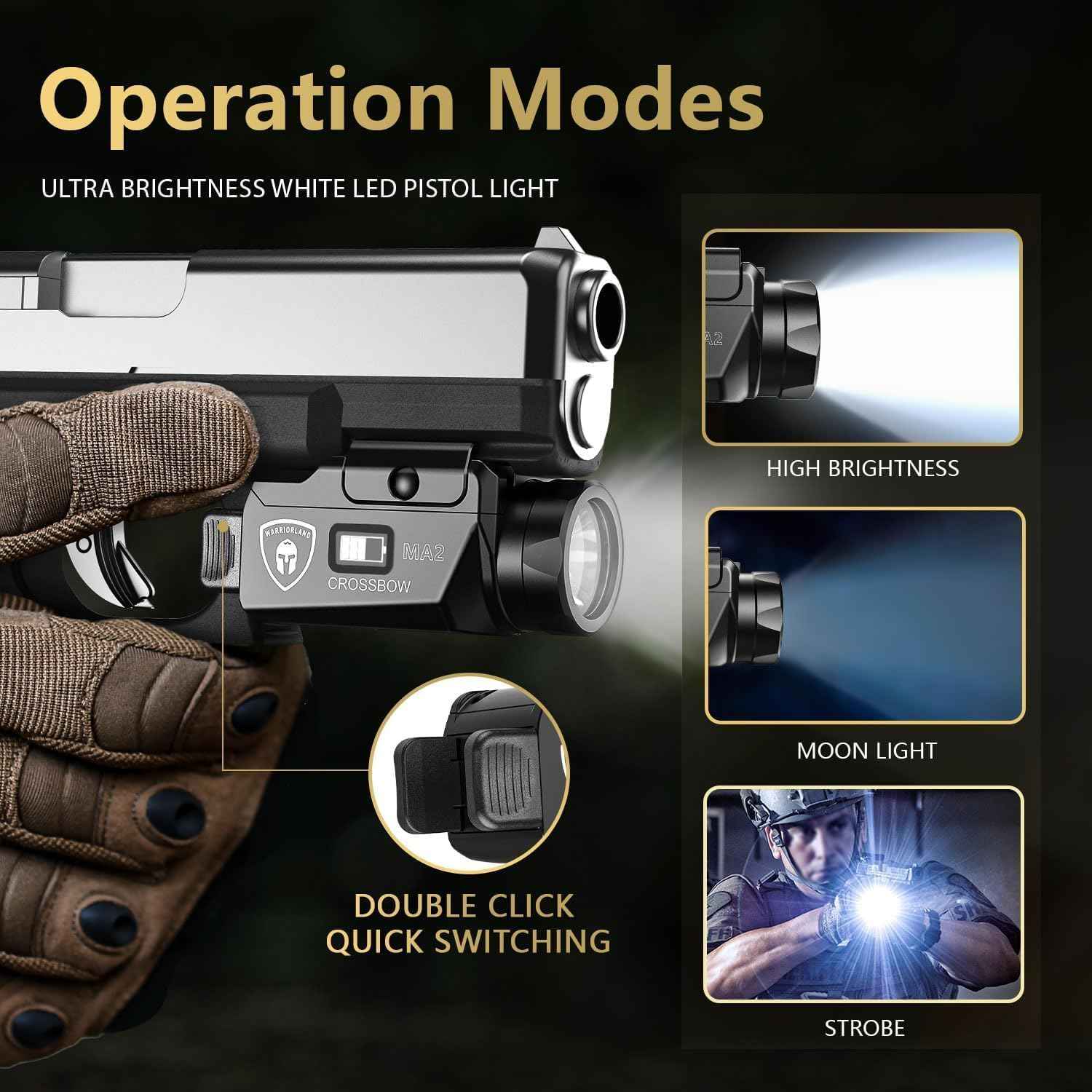
WARRIORLAND's MA2 series delivers 800-lumen output — the practical sweet spot for most civilian defensive scenarios. Adequate for indoor home defense without excessive blowback risk, sufficient for outdoor use at typical defensive distances, and compact enough for practical concealed carry with a light-bearing holster.
- WARRIORLAND MA2 Compact Pistol Light — Universal Rail Mount, 800 Lumens, Fits 60+ Handguns — 800-lumen output, screen power indicator for battery status, magnetic USB recharging. Compatible with Glock 17/19, P365, Taurus G3C/G2C, M&P 9, Hellcat Pro, 1911, and 60+ additional handguns. The universal 800-lumen solution for carriers who want practical output without the blowback risk of maximum-output lights.
- MA2 Pistol Light with Holster — S&W M&P Shield 9mm EZ — 800-lumen weapon light with platform-specific IWB holster. Complete light-equipped carry solution for M&P Shield EZ carriers.
- MA2 Pistol Light with Holster — Glock 20/21/22/23 Gen3-5 & Glock 34 Gen4 — 800-lumen weapon light with IWB holster for the larger Glock frame platforms.
- MA2 Pistol Light with Holster — Springfield Hellcat Pro — 800-lumen weapon light with IWB holster. Complete light-equipped carry solution for Hellcat Pro carriers.
800-Lumen Rail-Mounted Light + Laser Combo: Illumination and Aiming
For carriers who want both weapon light capability and a laser aiming device, the MA1 series combines 800-lumen white LED output with a green laser — providing target identification, disorientation, and rapid aiming capability in a single rail-mounted package.
- WARRIORLAND MA1 FDE — 800 Lumens, Green Laser & White LED, Fits 100+ Models — 800-lumen white LED with green laser. Compatible with Glock 17/19, P320, Taurus G2C, Hellcat Pro, Echelon, and 100+ additional models. Battery indicator screen, magnetic USB recharging.
- MA1 Laser Light Combo with Holster — M&P Shield 9mm EZ — 800-lumen LED and green laser with platform-specific IWB holster. Complete light-and-laser carry solution for M&P Shield EZ carriers.
- MA1 FDE Laser Light Combo with Holster — Hellcat Pro — 800-lumen LED and green laser in FDE finish with IWB holster. Complete light-and-laser carry solution for Hellcat Pro carriers.
150-Lumen Trigger-Mounted: Right-Sized for Subcompact Carry
For subcompact pistols without accessory rails — where size and weight constraints make full-output rail-mounted lights impractical — the SLL-105 provides 150-lumen output in a trigger-guard-mounted package. At the close-range distances typical of subcompact carry scenarios, 150 lumens provides adequate target identification and meaningful disorientation without the blowback risk of higher-output lights in confined spaces.
- WARRIORLAND SLL-100 — 150-Lumen Pistol Light & Green/Red Laser for Glock 43X MOS — 150-lumen tactical flashlight with green/red laser sight. Purpose-built for the Glock 43X MOS platform.
- SLL-105 Light/Laser with IWB Holster — Glock 43/43X (No Rail) — 150-lumen trigger-mounted light/laser with platform-specific IWB holster. The complete light-equipped carry solution for no-rail Glock 43/43X carriers — right-sized output for close-range subcompact defensive use.
The Honest Lumen Recommendation
For Most Civilian Defensive Carriers
For the majority of civilian defensive carriers — home defense in a typical residential environment, concealed carry in urban and suburban settings, close-range defensive distances — the honest lumen recommendation is 500–800 lumens. This output range:
- Provides adequate target identification at typical defensive distances
- Produces meaningful disorientation effect in dark environments
- Manages blowback risk in indoor environments
- Supports reasonable battery runtime
- Is available in compact, carry-practical form factors
- Is compatible with a wide range of light-bearing holsters
Outputs above 1,000 lumens provide incremental performance improvements in outdoor environments and at longer distances, but introduce blowback risk in indoor environments and reduce battery runtime. For most civilian defensive scenarios, the incremental benefit doesn't justify the trade-offs.
When Higher Output Is Justified
Higher output (1,000+ lumens) is justified when:
- The primary defensive scenario is outdoor use at longer distances
- The carrier is law enforcement or security with outdoor patrol duties
- The defensive environment is large (warehouse, commercial space) where distance reduces blowback risk
- The light has multiple output modes that allow lower output for indoor use and higher output for outdoor use
When Lower Output Is Appropriate
Lower output (150–500 lumens) is appropriate when:
- The pistol is a subcompact or micro-compact without a rail, where trigger-mounted lights are the only option
- The primary defensive scenario is vehicle defense, where blowback risk is extreme
- Battery runtime is a priority over maximum output
- The defensive environment is consistently small and confined
Conclusion: Match Output to Environment, Not to Marketing
The lumen arms race in weapon light marketing has produced lights with impressive specifications that don't always translate to better real-world defensive performance. More lumens is better — up to a point. Beyond that point, additional output introduces trade-offs (blowback, battery life, size, cost) that may outweigh the performance benefits for your specific defensive context.
The right lumen output for a weapon light is the output that matches your environment, your expected engagement distances, and your carry platform. For most civilian defensive carriers, that's 500–800 lumens — enough to identify threats, disorient adversaries, and deter attacks without the blowback risk that maximum-output lights introduce in indoor environments.
Evaluate weapon lights by the complete specification picture — lumens, candela, beam pattern, runtime, activation mechanism, durability, and holster compatibility — not by lumen output alone. The light that performs best in your specific defensive context is the right light, regardless of where it falls in the lumen competition.
WARRIORLAND's weapon light lineup — from the 800-lumen MA2 universal rail-mounted light to the 800-lumen MA1 light/laser combo to the 150-lumen SLL-105 for no-rail subcompact carry — is built around the practical output ranges that match real-world defensive scenarios. Find the output that fits your environment. Build the complete system. Carry with confidence.