
The Objection Every Weapon Light Owner Has Heard
"A flashlight just tells the bad guy where you are."
It's one of the most persistent arguments against mounting a weapon light on a defensive pistol — and it sounds tactically sophisticated. The idea is intuitive: light reveals your position, and in a defensive encounter, revealing your position is dangerous. Therefore, a weapon light is a liability.
This argument has a kernel of truth wrapped around a fundamental misunderstanding of how defensive encounters actually unfold. It conflates military special operations tactics — where concealing your position from a distant, armed adversary in a dark environment is a genuine tactical priority — with civilian defensive scenarios, where the dynamics are almost entirely different.
This guide addresses the position-reveal argument directly, explains why the calculus is different for civilian defensive carry than for military operations, and makes the case for why a mounted weapon light is one of the most practically important accessories a defensive carrier can add to their pistol.
What a Weapon Light Actually Does in a Defensive Encounter
Identification: The Most Critical Function
The most important function of a weapon light in a defensive encounter is not illumination for shooting — it's identification of the threat.
You cannot legally or morally shoot at a shape in the darkness. You must be able to identify your target — to confirm that what you're pointing your pistol at is actually a threat, not a family member, a neighbor, a pet, or an innocent bystander. In low-light conditions, this identification is impossible without a light source.
The legal and moral stakes of this identification requirement are enormous. Shooting an innocent person in the dark because you couldn't identify them is not a defensive shooting — it's a tragedy and potentially a crime. The weapon light is what makes positive identification possible in the conditions where most home invasions and many street crimes occur: darkness or low light.
This identification function alone justifies the weapon light. Everything else is secondary.
Disorientation and Psychological Effect
A high-output weapon light — 800 lumens or more — directed at an adversary's face in a dark environment has a significant disorienting effect. The sudden transition from darkness to intense light causes temporary vision impairment, disrupts the adversary's ability to accurately assess the situation, and creates a psychological shock that can interrupt their decision-making.
This disorientation effect works in the defender's favor. While the adversary is temporarily blinded and disoriented, the defender has a clear view of the threat and can make informed decisions about how to respond. The light doesn't just reveal the adversary — it degrades their ability to effectively respond to the defender.
This is the opposite of the position-reveal argument's implication. The light doesn't just tell the adversary where you are — it simultaneously tells you where they are while impairing their ability to effectively engage you.
Deterrence
Many defensive encounters end without shots fired — the adversary sees that the defender is armed and prepared, and chooses to disengage. A weapon light contributes to this deterrence effect. An adversary who is suddenly illuminated by a bright light attached to a pistol receives a clear, unambiguous message: the defender is armed, prepared, and has identified them. This combination — armed, prepared, identified — is a powerful deterrent that can end an encounter before it escalates to violence.
The position-reveal argument ignores this deterrence function entirely. In many cases, the best outcome of a defensive encounter is that no shots are fired — and the weapon light contributes to achieving that outcome.
Accuracy Under Stress
If shots must be fired, the weapon light provides a critical accuracy advantage. In low-light conditions without a weapon light, the defender must choose between using their sights (which requires looking away from the threat) and tracking the threat (which means shooting without sight alignment). Neither option is ideal.
With a weapon light, the defender can see both the threat and their sights simultaneously. The illuminated target and the illuminated sights allow for accurate shot placement that is simply not possible in darkness without a light source. In a defensive encounter where accurate shot placement is both a legal requirement and a practical necessity, this accuracy advantage is significant.
Where the "Gives Away Your Position" Argument Comes From
The Military Context Where It's Valid
The position-reveal concern originates in military and law enforcement tactical doctrine — specifically, in scenarios where operators are moving through dark environments against adversaries who are actively hunting them at distance. In these scenarios, the concern is legitimate:
- The adversary is at distance — potentially 50, 100, or 200+ meters away
- The adversary is armed and actively looking for targets
- The adversary has time to react to a light source and engage before the operator can identify and neutralize the threat
- The operator's position is not already known to the adversary
- Concealment of position is a genuine tactical advantage
In this context — a military patrol moving through a hostile village, a SWAT team clearing a building with a barricaded suspect — light discipline is a real tactical consideration. Operators use night vision equipment, infrared lasers, and careful light management to avoid revealing their positions.
This is the context from which the "flashlight gives away your position" argument derives. It's a valid tactical principle — in that specific context.
Why the Civilian Context Is Fundamentally Different
The civilian defensive encounter almost never resembles the military scenario where light discipline matters. Consider the realistic parameters of a civilian defensive encounter:
Distance: The vast majority of civilian defensive shootings occur at distances of 0–21 feet — often much closer. At these distances, the adversary already knows approximately where you are. You are not concealed from them; you are in the same room, the same hallway, the same parking lot. Your position is not a secret.
Duration: Civilian defensive encounters are typically extremely brief — seconds, not minutes. There is no extended period during which the adversary is searching for your position. The encounter begins with both parties already aware of each other's general location.
The adversary's intent: In a civilian defensive scenario, the adversary is typically not a trained combatant executing a tactical search pattern. They are a criminal who has chosen a target of opportunity. Their decision-making is driven by risk assessment — is this target worth the risk? — not by tactical doctrine.
Your position is already known: If you're in your home during a home invasion, the intruder knows you're in the house. If you're in a parking lot being approached by a mugger, they can see you. The scenario where a civilian defender is concealed from an adversary who is actively searching for them — the scenario where light discipline matters — is vanishingly rare in civilian defensive contexts.
The Home Defense Context: Where Weapon Lights Matter Most
The Realistic Home Invasion Scenario
Consider the most common civilian defensive scenario where a weapon light is relevant: a home invasion at night. You wake to the sound of breaking glass or a door being forced. You retrieve your pistol. You move to investigate or to protect your family.
In this scenario:
- You are in your own home — you know the layout; the intruder may not
- The intruder knows someone is in the house — your position is not secret
- You need to identify who is in your home before you can make any defensive decision
- Your family members may be moving through the same dark spaces
- The distance to any threat is measured in feet, not meters
In this scenario, the position-reveal argument collapses entirely. The intruder already knows you're in the house. What you need — desperately — is the ability to identify what you're pointing your pistol at before you make any decision to fire. A weapon light provides that identification capability. The absence of a weapon light creates the risk of shooting a family member in the dark.
The weapon light is not a tactical liability in this scenario. It is a moral and legal necessity.
The "Use a Handheld Flashlight" Counter-Argument
Some carriers who accept the need for a light source in defensive scenarios argue that a handheld flashlight is preferable to a weapon-mounted light — because the handheld light can be used without pointing the pistol at whatever you're illuminating.
This argument has merit in one specific context: searching and investigating. When you're moving through your home investigating a sound, you should not be pointing your pistol at every shadow you illuminate. A handheld flashlight allows you to illuminate without muzzling everything in your path.
However, the handheld flashlight argument has a critical limitation: it requires two hands. When you need to use your pistol — when the threat has been identified and a defensive response is required — you need both hands on the pistol for a stable, accurate shooting platform. A handheld flashlight in the support hand compromises your grip, your stability, and your accuracy.
The practical solution that experienced instructors recommend: carry both. A handheld flashlight for searching and investigating; a weapon-mounted light for the moment when the threat is identified and the pistol must be deployed. The weapon-mounted light is not a replacement for a handheld flashlight — it's a complement to it.
The "Gives Away Your Position" Argument: A Point-by-Point Rebuttal
"The light tells the attacker where to shoot."
Reality: At the distances typical of civilian defensive encounters (0–21 feet), the attacker already knows where you are. You are not concealed. The light doesn't reveal your position — your presence in the same space already has. What the light does is reveal the attacker's position to you, illuminate them for identification, and potentially disorient them with its output.
"You should use darkness as cover."
Reality: Darkness is not cover — it doesn't stop bullets. It's concealment, and only if the attacker doesn't know your general location. In a home invasion, the attacker knows you're in the house. In a street encounter, they can see you. The darkness that conceals you also prevents you from identifying the threat, which is a legal and moral requirement before firing. Using darkness as concealment while being unable to identify your target is not a defensive strategy — it's a recipe for tragedy.
"Military operators use light discipline, so civilians should too."
Reality: Military operators use light discipline in scenarios where they are moving through environments against adversaries at distance who are actively searching for them. Civilian defensive encounters almost never match these parameters. Military tactics are developed for military scenarios; applying them wholesale to civilian defensive contexts produces incorrect conclusions. The civilian defender's priorities — identification, deterrence, accurate response — are better served by a weapon light than by light discipline.
"A bright light makes you a target."
Reality: You are already a target — that's why the encounter is happening. The question is not whether you're a target but whether you can identify the threat, respond accurately, and deter or stop the attack. A weapon light improves your ability to do all three. The alternative — being unable to identify the threat in darkness — is not safer. It's more dangerous, because you cannot make informed defensive decisions without knowing what you're responding to.
When Light Discipline Actually Matters for Civilians
The position-reveal argument isn't entirely without merit for civilian contexts — it just applies in a much narrower set of circumstances than its proponents suggest.
Extended searching in a large, dark space: If you're moving through a large building — a warehouse, a large commercial space — where an adversary could be at significant distance and your position is genuinely unknown to them, light discipline becomes more relevant. Using a handheld flashlight intermittently rather than a continuously-on weapon light makes tactical sense in this scenario.
When the adversary is at distance and armed: If you have reason to believe an armed adversary is at significant distance and actively searching for you, light discipline is appropriate. This scenario is extremely rare in civilian defensive contexts but not impossible.
The practical solution: A weapon light with a momentary-on activation mode — which illuminates only while the activation button is pressed — allows the carrier to use light intermittently rather than continuously. This provides the identification and accuracy benefits of a weapon light while allowing some degree of light discipline when the tactical situation warrants it. Most quality weapon lights include both momentary-on and constant-on modes for exactly this reason.
Practical Considerations for Mounting a Weapon Light
Output: How Many Lumens Do You Need?
For defensive use, 500 lumens is a practical minimum for indoor environments; 800+ lumens provides meaningful disorientation effect and adequate outdoor illumination. The disorientation effect — one of the weapon light's key defensive advantages — scales with output. A 150-lumen light illuminates; an 800-lumen light illuminates and disorients.
For home defense in typical residential spaces, 500–800 lumens is the practical sweet spot. For outdoor use or larger spaces, 800+ lumens provides better performance.
Activation: Momentary vs Constant-On
Quality weapon lights offer both momentary-on (light is on only while the button is pressed) and constant-on (light stays on after a single press) modes. For defensive carry, momentary-on is the primary mode — it allows the carrier to use light intermittently and prevents the light from remaining on if the pistol is dropped or the hand is injured. Constant-on is useful for extended searching when both hands are occupied.
The activation mechanism's location matters: the light should be activatable without breaking the firing grip or repositioning the hand.
Mounting: Rail-Mounted vs Trigger-Mounted
Rail-mounted weapon lights attach to the pistol's accessory rail below the barrel — the standard mounting position for full-size and compact pistols that include an accessory rail. Rail-mounted lights are more secure, more powerful, and more feature-rich than trigger-mounted alternatives.
Trigger-mounted lights attach to the trigger guard rather than a rail, providing a mounting solution for subcompact and micro-compact pistols that lack accessory rails. These lights are typically lower output than rail-mounted options but provide weapon-light capability for platforms that would otherwise have none.
The Holster Requirement
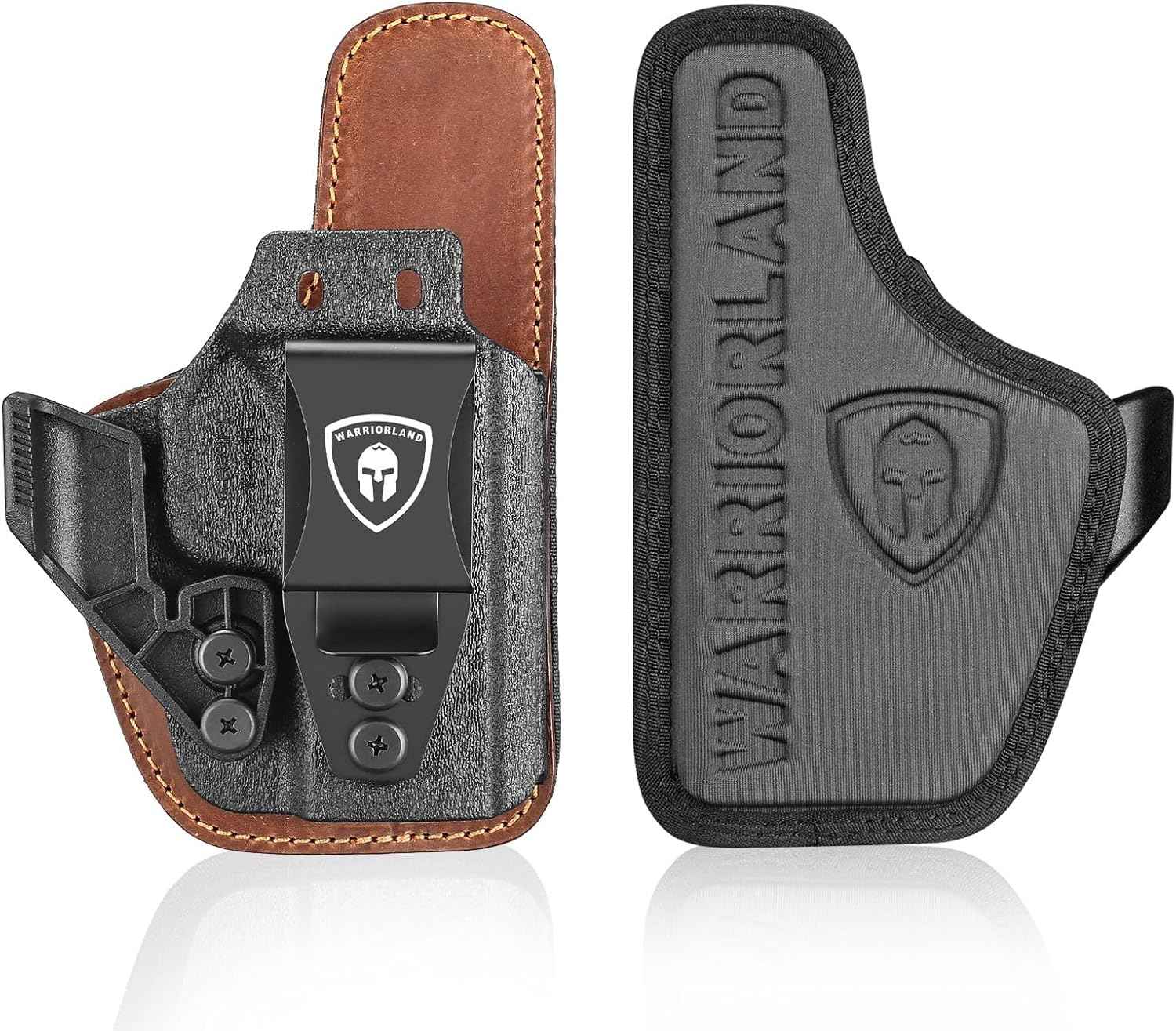
Mounting a weapon light changes the pistol's dimensions, making it incompatible with standard holsters. A light-bearing holster — designed specifically for the pistol-plus-light combination — is required. Using a standard holster with a light-equipped pistol, or removing the light to use a standard holster, defeats the purpose of the weapon light system entirely.
WARRIORLAND Weapon Light Solutions
Rail-Mounted: Full-Power Defensive Illumination
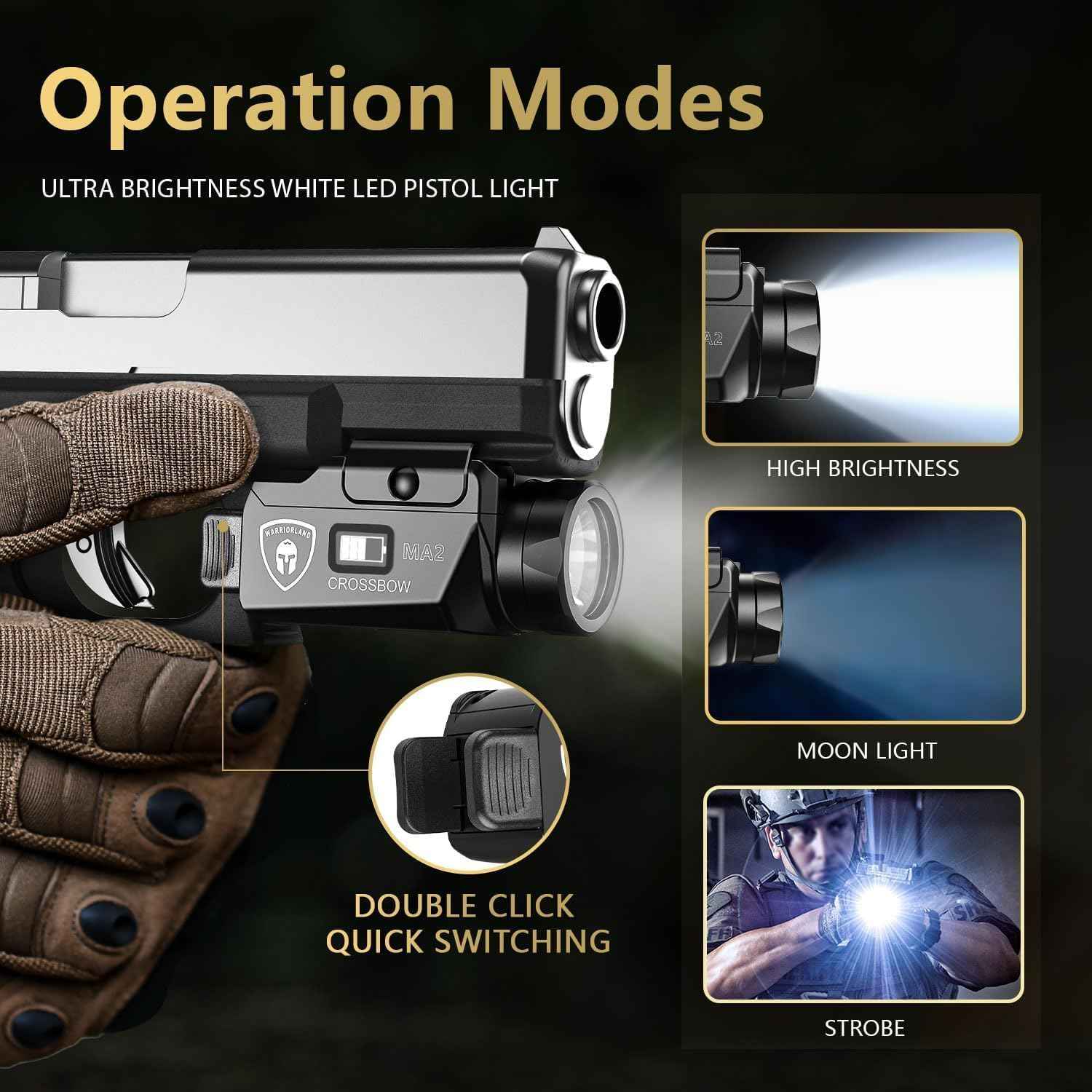
For pistols with standard accessory rails, WARRIORLAND's MA2 series provides 800-lumen output with magnetic USB recharging and a screen-displayed battery status indicator — eliminating the uncertainty of not knowing remaining battery life before a carry session.
- WARRIORLAND MA2 Compact Pistol Light — Universal Rail Mount, 800 Lumens, Fits 60+ Handguns — Compatible with Glock 17/19, P365, Taurus G3C/G2C, M&P 9, Hellcat Pro, 1911, and 60+ additional handguns. 800-lumen output, screen power indicator, magnetic USB recharging. The universal rail-mounted solution for carriers who want maximum output without platform-specific limitations.
- MA2 Pistol Light with Holster — M&P 9mm M2.0 3.6"/4.0"/4.25" Barrel — 800-lumen weapon light with platform-specific IWB holster. Complete light-equipped carry solution for M&P M2.0 carriers.
- MA2 Pistol Light with Holster — S&W M&P Shield 9mm EZ — 800-lumen weapon light with right-hand IWB holster. Complete carry solution for M&P Shield EZ carriers.
- MA2 Pistol Light with Holster — Springfield Hellcat Pro — 800-lumen weapon light with IWB holster. Complete light-equipped carry solution for Hellcat Pro carriers.
- MA2 Pistol Light with Holster — Glock 20/21/22/23 Gen3-5 & Glock 34 Gen4 — 800-lumen weapon light with IWB holster for the larger Glock frame platforms.
Rail-Mounted Light + Laser Combo: Illumination and Aiming
For carriers who want both weapon light capability and a laser aiming device in a single rail-mounted package, the Crossbow MA1 series combines 800-lumen white LED output with a green laser — providing both the identification and disorientation benefits of a weapon light and the rapid target acquisition advantage of a visible laser.
- Crossbow MA1 Light/Laser Combo with Glock 17/19 Kydex Holster — Green laser and white LED tactical light with platform-specific Glock 17/19 holster. Magnetic USB recharging, screen battery display. Complete light-and-laser carry solution for the most popular Glock platforms.
- Crossbow MA1 Light/Laser Combo with M&P 9mm 4.0"/4.25" OWB Holster — Green laser and white LED with M&P 9mm OWB holster. Complete light-and-laser solution for M&P carriers who prefer OWB carry.
- Crossbow MA1 Light/Laser Combo with Glock 21/20/22 Gen3-5 & G34 Gen4 Holster — Green laser and white LED with platform-specific holster for larger Glock frame platforms.
OWB Light-Bearing Holster: Duty and Open Carry
- Glock 17/19/19X/45 Gen3-5 OWB Light-Bearing Holster — TLR-7A / TLR-7X / TLR-7 HL-X / TLR-8A / TLR-8X — Precision-fit OWB Kydex for Glock platforms with Streamlight TLR-7/8 series lights. Thumb release active retention, optic cut, 2.0" mid-ride belt loop. The complete OWB solution for light-equipped Glock duty and open carry.
Trigger-Mounted: Weapon Light for No-Rail Pistols
For subcompact pistols without accessory rails — the Glock 42/43/43X/48 being the most common examples — trigger-mounted light/laser combinations provide weapon light capability without requiring a rail.
- SLL-105 Trigger-Mounted Light/Laser — Glock 42/43/43X/48 (No Rail) — 150-lumen white LED with red laser. Trigger-mounted for no-rail Glock platforms. Three light modes, power indicator. Weapon light capability for the most popular subcompact Glock carry pistols.
- SLL-105 Light/Laser with IWB Holster — Glock 43/43X (No Rail) — 150-lumen trigger-mounted light/laser with platform-specific IWB holster. Complete light-equipped carry solution for no-rail Glock 43/43X carriers.
Building the Complete Light-Equipped Carry System
A complete light-equipped carry system requires three components working together:
- The weapon light: Matched to your pistol's rail (or trigger guard for no-rail pistols), with adequate output for your defensive context, and activation controls accessible without breaking your firing grip.
- The light-bearing holster: Designed specifically for your pistol-plus-light combination. Platform-specific fit matters — a holster designed for a different light model may not fit correctly.
- Training: The weapon light must be integrated into your draw stroke and defensive technique. Activating the light, managing momentary vs constant-on modes, and re-holstering with the light attached all require dedicated practice. A weapon light that isn't trained with is a weapon light that won't be used correctly under stress.
Low-light training — practicing your defensive technique in reduced-light conditions with your weapon light — is the only way to develop the skills needed to use the system effectively under stress. Many shooting ranges offer low-light training sessions; seek them out and practice your complete system, not just the pistol in isolation.
Conclusion: The Light Is Not the Liability — The Darkness Is
The "weapon light gives away your position" argument sounds tactical but fails under scrutiny when applied to civilian defensive contexts. At the distances, durations, and dynamics of realistic civilian defensive encounters, your position is not a secret — and the inability to identify a threat in darkness is far more dangerous than any position-reveal risk the light creates.
The weapon light's functions — threat identification, disorientation of the adversary, deterrence, and accuracy support — address the actual challenges of low-light defensive encounters. The position-reveal concern addresses a scenario that rarely applies to civilian defensive use.
Mount the light. Train with it. Carry it in a holster designed for the combination. And understand that in the darkness where most home invasions occur, the light isn't what puts you at risk — the darkness is.
WARRIORLAND's weapon light lineup — from the universal 800-lumen MA2 to the MA1 light/laser combo with Glock holster to the SLL-105 trigger-mounted solution for no-rail pistols — provides complete light-equipped carry solutions for every platform and carry context. The light is the tool. The training is what makes it work. Build the complete system.