
The Small Piece of Plastic That Solves Concealment's Biggest Problem
If you've spent any time researching IWB holsters, you've seen the term "claw" or "concealment claw" appear repeatedly in product descriptions and carry community discussions. Some carriers swear by them. Others aren't sure what they do or whether they need one. A few dismiss them as marketing gimmicks.
The claw is not a gimmick. It's one of the most practically effective concealment improvements available for inside-the-waistband carry — a simple mechanical solution to the most common concealment problem that IWB carriers face. Understanding what it does, how it works, and when you need one will meaningfully improve your concealed carry setup.
This guide covers everything: the physics behind the claw, how it interacts with your belt and waistband, which carry positions benefit most, what to look for when evaluating claw designs, and which WARRIORLAND holsters include claw attachments for the most popular carry platforms.
The Core Problem: Grip Printing
Why the Grip Is the Hardest Part to Conceal
When most people think about concealing a pistol, they think about the bulk of the slide and frame. In practice, the grip — specifically the grip's upper portion near the trigger guard — is the part most likely to print through clothing and reveal the pistol's presence.
Here's why: when you carry IWB, the holster clips to your belt and the pistol sits inside your waistband. The slide and most of the frame are below the beltline, hidden by your pants. But the grip extends above the beltline, covered only by your cover garment. The grip's angle relative to your body determines how much it protrudes outward — and how visible it is through your shirt.
In a standard IWB holster without a claw, the grip naturally angles away from the body. The holster hangs vertically from the belt clip, and the grip follows the pistol's natural geometry — angling outward from the body at the top. This outward angle creates a visible bulge under the cover garment, especially when the garment is lightweight or fitted. The grip pushes against the fabric from the inside, creating a telltale outline that experienced observers recognize immediately.
This is the printing problem that the claw solves.
What Is a Holster Claw?
The Basic Definition
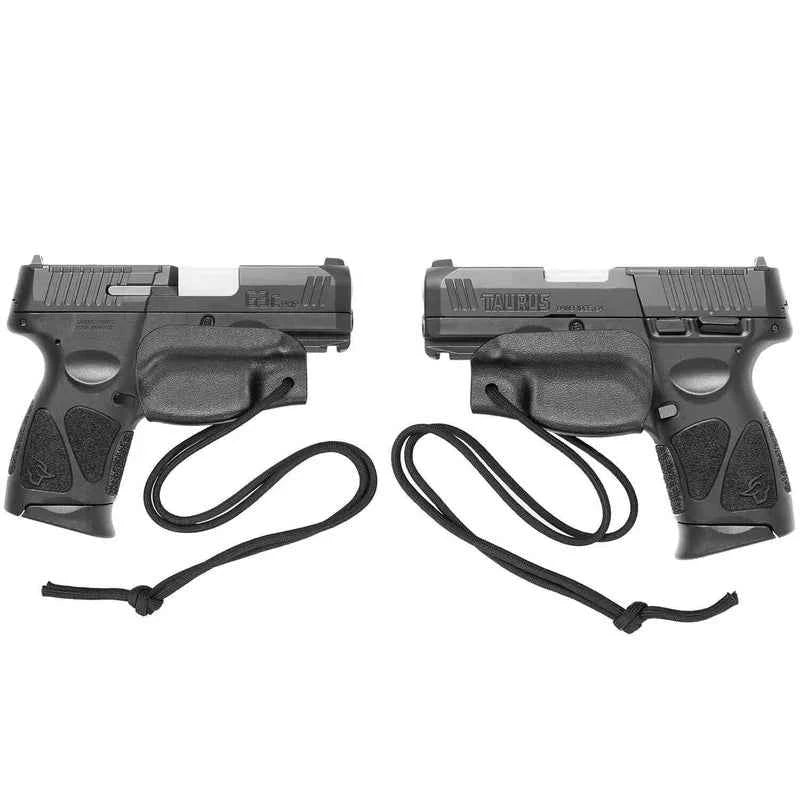
A holster claw — also called a concealment claw, anti-print claw, or simply a "wing" — is a small protrusion attached to the body of an IWB holster, typically positioned near the trigger guard area on the side facing away from the body. When the holster is worn, the claw presses against the inside of the waistband or belt, using that pressure as a lever to rotate the grip of the pistol inward toward the body.
The result: the grip tucks closer to the body rather than angling outward, dramatically reducing the visible profile under a cover garment. The same pistol in the same holster at the same carry position conceals significantly better with a claw than without one.
The Mechanics: How the Claw Actually Works
The claw's operation is based on a simple lever principle. Here's the sequence:
- The holster clips to your belt, with the holster body sitting inside the waistband
- The claw protrudes outward from the holster body, toward the inside of the waistband or belt
- As you tighten your belt or as the waistband naturally presses inward, the claw contacts the belt or waistband material
- This contact creates a pressure point that acts as a fulcrum
- The pressure pushes the bottom of the holster (near the trigger guard and claw) outward, away from the body
- Because the holster is attached to the belt clip at the top, this outward push at the bottom rotates the entire holster — pivoting around the belt clip
- The rotation drives the grip (at the top of the holster) inward, toward the body
- The grip tucks against the body rather than angling away from it
The claw doesn't add bulk or change the holster's retention. It simply redirects the natural forces of the belt and waistband to rotate the holster into a more concealable position. The physics are elegant: the belt that holds the holster in place also provides the force that improves concealment.
What the Claw Is Not
Understanding what the claw doesn't do is as important as understanding what it does:
- It's not a retention device: The claw doesn't hold the pistol in the holster. Retention is handled by the holster's shell and retention adjustment screw.
- It's not a safety device: The claw doesn't prevent the trigger from being accessed. Trigger guard coverage is the holster shell's job.
- It's not a cant adjustment: The claw affects the grip's inward/outward angle, not the forward/backward cant. Cant is adjusted separately.
- It doesn't work without a belt: The claw requires something to push against — a proper gun belt or at minimum a sturdy waistband. It won't function effectively without adequate belt pressure.
Claw vs No Claw: The Real-World Difference
How Much Does It Actually Help?
The concealment improvement from a claw varies based on several factors: body type, carry position, belt stiffness, cover garment weight, and pistol size. But the community consensus from thousands of carriers who have compared both configurations is consistent: the claw makes a meaningful, visible difference in most setups.
Carriers who have switched from no-claw to claw holsters consistently report:
- The grip no longer pushes visibly against the cover garment
- They can wear lighter, more fitted cover garments without printing
- The pistol feels more stable and closer to the body during movement
- They're less conscious of the pistol's presence during daily activities
- Bending, reaching, and sitting create less visible printing
The improvement is most dramatic for carriers with larger pistols (full-size and compact frames), AIWB appendix carriers where the grip is most visible, and carriers who wear lighter or more fitted clothing. For carriers with small subcompact pistols, heavy cover garments, or very loose clothing, the improvement is real but less dramatic.
When the Claw Makes the Biggest Difference
Appendix carry (AIWB): The claw's impact is most significant for appendix inside-the-waistband carry. In AIWB, the pistol sits at the front of the body where the grip is most visible — directly in front of the body where any outward angle is immediately apparent. The claw's rotation of the grip inward is most effective and most noticeable in this position. Most serious AIWB carriers consider the claw non-negotiable.
Strong-side IWB (3-4 o'clock): The claw provides meaningful improvement for strong-side carry as well, particularly for carriers with larger pistols or those who wear fitted clothing. The grip at the hip is less visible than at the appendix position, but the claw still reduces printing noticeably.
Larger pistols: Full-size and compact pistols have longer grips that extend further above the beltline, creating more opportunity for printing. The claw's rotation improvement is proportionally more valuable for larger pistols than for subcompacts.
Lighter cover garments: A heavy jacket conceals printing regardless of claw presence. A thin t-shirt or lightweight button-down reveals every contour. The claw's improvement is most valuable when the cover garment provides minimal concealment on its own.
Claw Design Variations: Not All Claws Are Equal
Fixed vs Adjustable Claws
Fixed claws are molded or permanently attached to the holster body at a set angle and position. They're simpler, more durable, and less likely to loosen or shift during use. The trade-off is that the claw's effectiveness depends on how well the fixed position matches your specific belt, waistband, and body geometry.
Adjustable claws can be repositioned along the holster body or adjusted in angle, allowing the carrier to optimize the claw's contact point for their specific setup. This adjustability is valuable for carriers who use different belts or who need to fine-tune the claw's rotation effect. The trade-off is additional mechanical complexity and potential for the adjustment to loosen over time.
Claw Size and Shape
Claw size affects how aggressively the grip is rotated inward. A larger claw with more surface area creates more leverage against the belt, producing more rotation. A smaller claw produces less rotation but may be more comfortable for some body types and carry positions.
The claw's shape — whether it's a simple protrusion, a curved hook, or a wing-style extension — affects how it contacts the belt and distributes pressure. Wing-style claws that contact a broader area of the belt tend to produce more consistent rotation than narrow point-contact claws.
Claw Material
Most claws are made from the same Kydex or polymer as the holster body. Kydex claws are rigid and maintain their shape under pressure, providing consistent rotation. Some holsters use softer polymer claws that flex slightly under belt pressure — these can be more comfortable but may provide less consistent rotation.
The Belt Factor: Why Your Belt Determines the Claw's Effectiveness
The Claw Needs Something to Push Against
The claw's lever mechanism requires adequate resistance from the belt or waistband to function. A stiff, properly sized gun belt provides the resistance the claw needs to generate meaningful rotation. A thin fashion belt or a stretchy waistband provides little resistance, and the claw's effectiveness is significantly reduced.
This is one of the most common reasons carriers report that their claw holster "doesn't work" — they're using an inadequate belt. The claw is doing its job; the belt isn't providing the resistance needed for the lever to function.
What Constitutes an Adequate Belt
- Stiffness: A gun belt should be stiff enough to resist the weight of the pistol without sagging or twisting. Leather gun belts and reinforced nylon gun belts provide this stiffness; standard fashion belts typically don't.
- Width: A 1.5" belt provides more surface area for the claw to contact than a 1" belt, generally producing more consistent rotation.
- Thickness: Thicker belts provide more resistance and a more defined contact surface for the claw.
If you're using a claw holster and not seeing the expected concealment improvement, the belt is the first thing to evaluate. Upgrading to a quality gun belt often produces more improvement than any holster modification.
Claw and Carry Position: Optimizing the Setup
AIWB Appendix Carry
For AIWB carry, the claw should be positioned to contact the inside of the waistband or belt at the point that produces the most inward rotation of the grip. Most AIWB holsters position the claw on the side of the holster facing the strong-side hip — as the belt presses inward from that side, the claw rotates the grip toward the body's centerline.
AIWB carriers often find that a slightly higher cant (muzzle angled more toward the strong side) combined with a claw produces the best concealment — the cant positions the grip more naturally against the body, and the claw maintains that position during movement.
Strong-Side IWB (3-4 O'Clock)
For strong-side carry, the claw contacts the belt or waistband on the side facing the body's rear. The rotation drives the grip forward and inward, reducing the outward angle that causes printing at the hip. The improvement is most noticeable when bending forward or reaching — movements that naturally push the grip outward without a claw.
Behind-the-Hip (4-5 O'Clock)
Behind-the-hip carry positions the pistol where the body's natural curve can help conceal the grip. A claw in this position provides additional improvement by maintaining the grip's inward angle even during movement. The claw is somewhat less critical in this position than for AIWB or strong-side carry, but still provides measurable improvement.
Common Claw Troubleshooting
"The Claw Isn't Doing Anything"
The most common complaint. Causes and solutions:
- Inadequate belt: The most common cause. Upgrade to a proper gun belt with adequate stiffness.
- Claw not contacting the belt: The claw may be positioned too low or at the wrong angle to contact the belt. Adjust the claw position if adjustable, or try a different belt width.
- Belt too loose: A loose belt doesn't press the waistband firmly enough for the claw to generate leverage. Tighten the belt until it provides firm support.
- Pants waistband too stiff: Some pants waistbands are stiff enough to prevent the claw from pressing against the belt. Try different pants or adjust the holster position.
"The Claw Is Uncomfortable"
Claw discomfort is usually caused by the claw pressing against the body rather than the belt. Solutions:
- Verify the claw is positioned to contact the belt, not the skin or clothing between the holster and body
- Adjust the holster's ride height so the claw contacts the belt at the correct point
- Try a smaller claw if available, or a claw with a rounded rather than sharp profile
"The Claw Rotates the Grip Too Far Inward"
Over-rotation can make the grip difficult to access during the draw. Solutions:
- Reduce belt tension slightly
- Use a smaller claw if the holster offers options
- Adjust the holster's cant to compensate for the rotation
- Move the holster slightly forward or backward to change the claw's contact angle
Do You Need a Claw? An Honest Assessment
You Probably Need a Claw If:
- You carry a full-size or compact pistol IWB and struggle with grip printing
- You carry AIWB and want maximum concealment under lighter clothing
- You wear fitted clothing or live in a warm climate where heavy cover garments aren't practical
- You've tried adjusting cant and ride height but still see the grip printing
- You want to carry a larger pistol without switching to a smaller one for concealment reasons
- You're conscious of the pistol's presence during daily activities and want it to feel more secure against the body
The Claw May Be Less Critical If:
- You carry a very small subcompact pistol with a short grip that doesn't extend far above the beltline
- You consistently wear heavy cover garments (jackets, heavy flannels) that conceal printing regardless
- You carry OWB where the claw mechanism doesn't apply
- You carry at behind-the-hip positions where the body's natural curve provides concealment
The Community Verdict
The concealed carry community's consensus is clear: for most IWB carriers, especially AIWB carriers and those carrying compact or full-size pistols, the claw is worth having. The cost is minimal — most claw-equipped holsters are priced comparably to non-claw versions — and the concealment improvement is real and consistent. The question isn't really "claw or no claw" for most carriers; it's "which claw holster is right for my platform."
WARRIORLAND Claw Holster Lineup
Every WARRIORLAND claw holster is built around the same core principle: rigid Kydex construction that maintains shape after the draw, complete trigger guard coverage, and a concealment claw engineered to work with standard gun belts across the full range of body types and carry positions. Here's the lineup by platform:
Glock Platform
- Glock 17/19 IWB Kydex Holster with Claw and Optic Cut — Covers Glock 17/19 Gen3-6, G34 Gen3-5, G17/G19 Gen4-5 MOS, G23/G22/G31/G32 Gen3-4, G19X, G44, G45, G45 MOS. Adjustable cant and retention. The flagship claw holster for the most popular Glock platforms.
- IWB Kydex Holster with Claw and Optic Cut — Appendix Carry — Glock 17/19 Gen3-6, G26, G34 Gen3-5, MOS versions, G19X, G26 Gen5 MOS, G34 Gen5 MOS, G44, G45, G45 MOS. Optimized for appendix carry with adjustable cant and retention.
- Glock 43X MOS IWB Kydex Holster with Claw — Also fits Glock 43/43X. Red dot optics ready. Appendix concealment carry optimized. The dedicated claw solution for the subcompact Glock platform.
- Clear Polymer IWB Holster for Glock 43/43X with Claw and Optic Cut — Transparent construction allows visual confirmation of trigger guard clearance during re-holstering — a meaningful safety feature for AIWB carry. Claw and optic cut included.
- 1.75" Metal Clip IWB Kydex Holster with Claw — Glock 17/19/26/44/45 Gen1-5 & G23/G32 Gen1-4 — Wide metal clip for enhanced stability. Claw attachment for concealment. Designed for larger frames and higher ride height preference.
SIG Sauer Platform
- SIG P320 Full Size / M17 Hybrid Kydex Leather-Lined IWB Holster with Claw — Leather-backed Kydex hybrid for all-day comfort. Claw attachment and optic cut. The comfort-first claw option for P320 Full Size and M17 carriers.
Springfield Armory Platform
- Springfield Hellcat Pro / Hellcat / RDP / OSP IWB Hybrid Holster with Claw — Kydex/leather hybrid construction. Optic cut, claw, adjustable cant, retention, and ride height. Covers the full Hellcat family in a comfort-first design.
- Springfield Hellcat / OSP / RDP Hybrid Kydex Leather-Lined IWB Holster with Claw and Optic Cut — Leather-lined comfort with Kydex retention and claw concealment. Designed for larger frames carrying the Hellcat platform.
Ruger Platform
- Ruger RXM IWB Kydex Holster with Claw and Optic Cut — Dedicated precision-fit holster for the Ruger RXM. Concealment claw, optic cut, adjustable cant and retention. Purpose-built for the RXM's Glock-compatible footprint.
Multi-Platform
- IWB Hybrid Holster with Claw — Glock 17/19 Gen3-5, G23/G32 Gen3-4, G19X, G44, G45, MOS versions, Ruger RXM / MR920 — Polymer and leather hybrid covering both Glock and Ruger RXM/MR920 platforms. Claw and optic cut included. The versatile claw option for carriers who use multiple compatible platforms.
- Taurus G3 IWB Kydex Holster with Claw and Optic Cut — Appendix concealment optimized. Claw and optic cut for the Taurus G3 platform.
- S&W Bodyguard 2.0 IWB Kydex Holster with Claw and Optic Cut — Concealed carry holster with optic cut, claw, adjustable cant, and audible retention lock for the Bodyguard 2.0 platform.
Conclusion: The Claw Is the Easiest Concealment Upgrade You Can Make
The holster claw is one of those rare accessories that delivers exactly what it promises: a simple, mechanical solution to a real concealment problem, with no trade-offs in draw speed, retention, or safety. It doesn't require changing your carry position, your cover garment, or your pistol. It works with the belt you're already wearing to rotate the grip into a more concealable position.
For IWB carriers — especially AIWB carriers and those carrying compact or full-size pistols — the claw is not a luxury feature. It's a practical tool that makes the difference between a setup that prints and a setup that disappears under a t-shirt.
The question isn't whether you need a claw. For most IWB carriers, you do. The question is which claw holster is right for your platform, your carry position, and your body. WARRIORLAND's claw holster lineup — from the Glock 17/19 IWB with claw to the Glock 43X AIWB with claw to the Hellcat Pro hybrid with claw — covers the full range of popular carry platforms with precision-engineered concealment solutions. Find your platform. Get the claw. Carry with confidence.