
Choosing the Right Sighting System Starts With Understanding What's Available
The sighting system on a defensive pistol is the interface between the shooter and the target — the mechanism by which the shooter aligns the weapon with the intended point of impact. It's one of the most consequential equipment decisions a defensive carrier makes, yet it's often treated as an afterthought: whatever came on the pistol from the factory is what gets used.
That approach leaves significant performance on the table. Modern sighting systems — from upgraded iron sights to miniature red dot sights to laser aiming devices — offer genuine performance advantages over factory-standard sights in specific scenarios. Understanding what each system offers, what it demands, and where it performs best is the foundation of an informed sighting system decision.
This guide covers every major pistol sighting system type: how each works, its advantages and limitations, the scenarios where it performs best, and how different systems can be combined for maximum defensive capability.
Iron Sights: The Foundation of All Pistol Shooting
How Iron Sights Work
Iron sights — the term covers any non-optical, non-electronic sighting system — require the shooter to align three elements: the rear sight, the front sight, and the target. The classic configuration is a notched rear sight and a post front sight; the shooter aligns the front post in the center of the rear notch, with the top of the front post level with the top of the rear sight, then places this aligned sight picture on the target.
This three-point alignment task is the fundamental skill of pistol marksmanship. Every other sighting system either simplifies this task (red dots reduce it to a two-point alignment: dot and target) or bypasses it entirely (lasers allow aiming without any sight alignment). But iron sights remain the baseline — the system that works without batteries, without electronics, and without any additional equipment beyond the pistol itself.
Standard Factory Iron Sights
Most production pistols ship with basic iron sights — typically a fixed rear sight and a fixed front sight, often made of polymer or low-quality steel, with minimal visibility features. These sights are functional but represent the minimum viable sighting system. They're adequate for close-range defensive use in good lighting but offer limited performance in low light, at distance, or under stress.
Night Sights: Tritium-Illuminated Iron Sights
Night sights replace standard iron sights with versions that incorporate tritium — a radioactive isotope that produces a continuous, battery-free glow. The tritium is sealed in glass vials set into the sight body; the glow is visible in darkness without any external power source and lasts approximately 10–12 years before the tritium decays to the point where the glow becomes too dim to be useful.
Night sights are the most common iron sight upgrade for defensive pistols. They provide the same three-point alignment as standard iron sights but with glowing reference points that are visible in darkness. The most common configuration is a three-dot system: one tritium dot in the front sight and two in the rear sight, aligned horizontally when the sights are properly aligned.
Advantages of night sights:
- No batteries required — the tritium glow is continuous and self-powered
- Visible in complete darkness without any external light source
- Durable and reliable — no electronics to fail
- Compatible with any holster designed for the base pistol
- Relatively low cost compared to electronic sighting systems
Limitations of night sights:
- Still require three-point alignment — the fundamental skill demand of iron sights remains
- Tritium glow is dim in ambient light — the dots are most useful in darkness, less so in low-light conditions with some ambient light
- Tritium decays over time — sights must be replaced after approximately 10–12 years
- No improvement in sight picture clarity or acquisition speed in daylight
Fiber Optic Sights: Daylight Brightness
Fiber optic sights use a thin rod of optical fiber that collects ambient light and concentrates it at the sight's aiming point, producing a bright, glowing dot that's highly visible in daylight. The front sight typically uses a bright red or green fiber optic rod; the rear sight may use fiber optic or standard notch configuration.
Fiber optic sights excel in bright daylight conditions where tritium night sights offer no advantage — the fiber optic's collected ambient light produces a brighter, more visible aiming point than a standard black front post. However, fiber optic sights provide no benefit in darkness (they require ambient light to function) and are more fragile than tritium or standard iron sights.
Best use case: Competition shooting and range use in daylight conditions. Less practical for defensive carry where low-light performance is a priority.
Combination Tritium/Fiber Optic Sights
The most versatile iron sight upgrade combines tritium and fiber optic in a single sight: a fiber optic rod surrounds a tritium vial, providing bright daylight visibility from the fiber optic and low-light visibility from the tritium. These combination sights — offered by manufacturers like Trijicon (HD XR series) and AmeriGlo — provide the best iron sight performance across all lighting conditions.
Miniature Red Dot Sights (MRDS): The Modern Standard
How Red Dot Sights Work
Miniature red dot sights (MRDS) — also called reflex sights or pistol optics — project a red (or green) illuminated dot onto a lens that the shooter looks through. The dot appears to float on the target; when the dot is on the target, the pistol is aimed at the target. Unlike iron sights, which require three-point alignment (rear sight, front sight, target), a red dot sight requires only two-point alignment: dot and target.
This reduction from three-point to two-point alignment is the red dot's primary performance advantage. The shooter focuses on the target — where the threat is — rather than on the front sight, which requires shifting focus away from the threat. The dot appears on the same focal plane as the target, allowing the shooter to maintain threat focus while aiming accurately.
The Optics-Ready Revolution
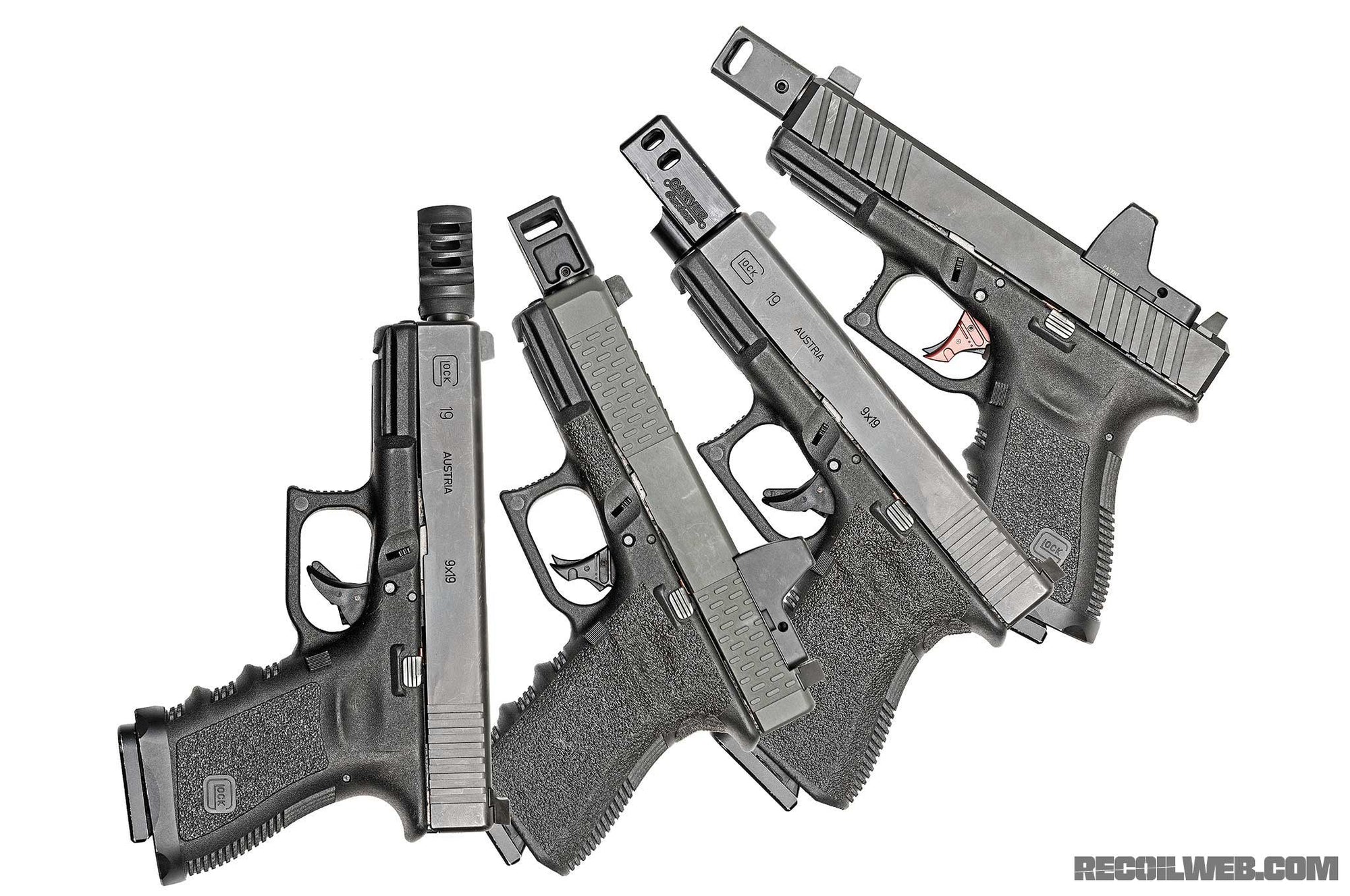
The widespread adoption of miniature red dot sights on pistols has been enabled by the proliferation of optics-ready slides — pistol slides with a milled cut (typically a Picatinny or proprietary footprint) that allows a red dot sight to be mounted directly to the slide. Most major pistol manufacturers now offer optics-ready variants of their popular models: the Glock MOS series, the SIG P320 RXP, the Springfield Armory Hellcat OSP, and many others.
Pistols without factory optics-ready slides can be milled by a gunsmith to accept a red dot, though this is a permanent modification that affects the pistol's resale value and requires careful selection of the milling pattern to match the intended optic's footprint.
Advantages of Miniature Red Dot Sights
- Two-point alignment: Dot and target, rather than rear sight, front sight, and target. Faster acquisition and less skill demand under stress.
- Target focus: The shooter maintains focus on the threat rather than shifting focus to the front sight. More natural and more reliable under stress.
- Precision at distance: The small dot subtends a smaller angle than a front sight post, allowing more precise aiming at longer distances.
- Adjustable brightness: Most MRDS units offer multiple brightness settings, allowing the dot to be visible in bright daylight or dimmed for low-light use.
- Works with any lighting: Unlike iron sights, which depend on the shooter's ability to see the sights, a red dot works in any lighting condition where the dot is visible — which is essentially all conditions.
- Faster target transitions: Moving the dot from one target to another is faster than re-aligning iron sights on a new target.
Limitations of Miniature Red Dot Sights
- Battery dependency: MRDS units require batteries. A dead battery means no dot. Quality units have battery lives measured in thousands of hours, but battery management is a real maintenance requirement.
- Training requirement: Finding the dot on the draw is a skill that requires practice. New MRDS users often struggle to locate the dot when presenting the pistol from the holster — a problem that resolves with training but requires investment.
- Holster compatibility: A pistol with a mounted red dot requires a holster specifically designed to accommodate the optic. Standard holsters will not fit an optic-equipped pistol.
- Durability concerns: MRDS units are electronic devices mounted on a reciprocating slide that experiences significant mechanical shock with each shot. Quality units are designed to withstand this, but budget optics may fail under sustained use.
- Cost: Quality MRDS units cost $200–$700+. Combined with the cost of an optics-ready pistol or slide milling, the total investment is significant.
Popular MRDS Footprints and Compatibility
MRDS units use various mounting footprints — the pattern of screw holes that attaches the optic to the slide. The most common footprints include the Shield RMSc (used by many compact pistols), the Trijicon RMR (the original standard for full-size pistols), the Leupold DeltaPoint Pro, and the Holosun 507/508 series. Optics-ready pistols specify which footprints their cuts accept; selecting an MRDS requires matching the optic's footprint to the pistol's cut.
For carriers running optic-equipped pistols, WARRIORLAND's optic-cut holsters provide the carry infrastructure that optics-ready pistols require:
- Glock 17/19/19X/44/45 Gen1-5 IWB Carbon Fiber Kydex Holster — Red Dot Optics Cut, Wing/Claw — Carbon fiber Kydex IWB holster with optic cut accommodating mounted red dot sights. Wing/claw for concealment, adjustable retention.
- Glock 17/19/19X/44/45 Gen3-5 IWB Kydex Holster — Optic Cut, Fits TLR-8/TLR-8A — Light-bearing IWB holster with optic cut for Glock platforms running TLR-8 series lights and a mounted red dot.
- Glock 17/19/19X/45 Gen3-5 OWB Kydex Light-Bearing Holster — Optic Cut, TLR-7A/TLR-8A Series — Outside-waistband light-bearing holster with optic cut, thumb release active retention, 2.0" mid-ride belt loop.
- IWB Kydex Holster for Hellcat Pro OSP with TLR-7X Sub / TLR-7 HL-X Sub — Optics Cut — Light-bearing IWB holster for the Hellcat Pro OSP with optic cut, adjustable cant and posi-click retention.
- IWB Kydex Holster for SIG P365-XMACRO with TLR-7X Sub / TLR-7 HL-X Sub — Optics Cut — Light-bearing IWB holster for the P365-XMACRO with optic cut, adjustable cant and posi-click retention.
Laser Aiming Devices: Bypassing Sight Alignment Entirely
How Laser Aiming Devices Work
Laser aiming devices project a visible laser beam onto the target, producing a dot that shows exactly where the pistol is aimed. Unlike iron sights (which require the shooter to look at the sights) and red dot sights (which require the shooter to look through the optic), a laser allows the shooter to aim by looking directly at the target and placing the laser dot on the intended point of impact.
This target-direct aiming capability is the laser's unique advantage: it allows accurate aiming from any position, including positions where the sights cannot be brought to eye level. A shooter who is injured, behind cover, or in a position that prevents a normal shooting stance can still aim accurately with a laser by placing the dot on the target.
Red Lasers vs Green Lasers: The Visibility Difference
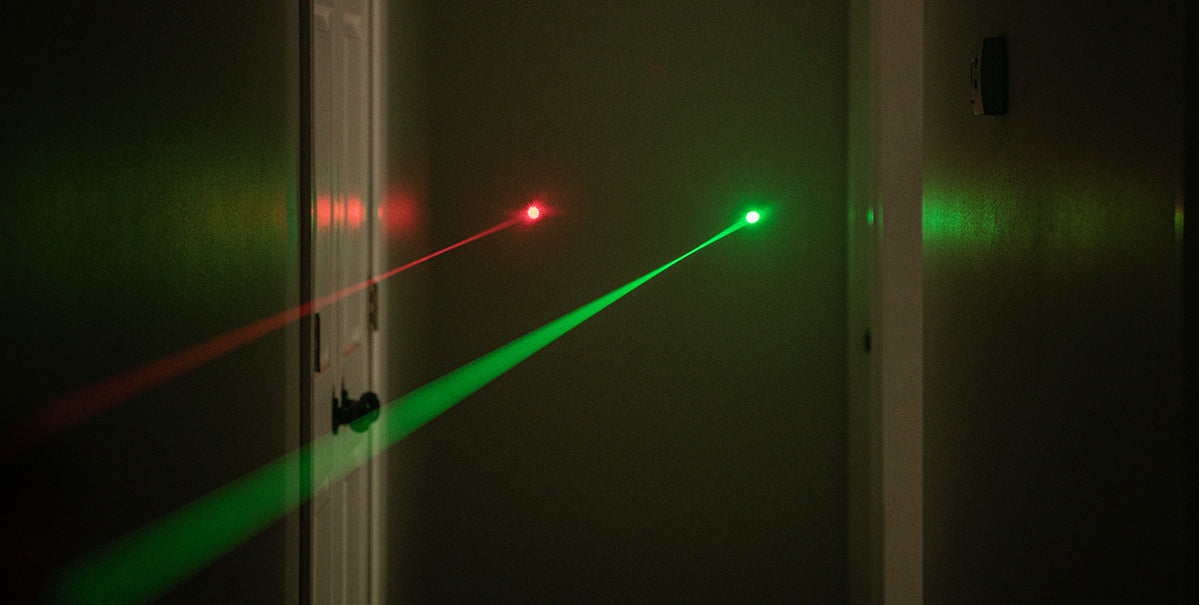
Laser aiming devices are available in red (typically 630–670nm) and green (typically 520–532nm). The human eye is approximately 4–5 times more sensitive to green light than red light at the same power output, making green lasers significantly more visible in ambient light conditions — particularly in daylight, where red lasers can be difficult or impossible to see.
Green lasers are the preferred choice for most defensive carry applications because of their superior daylight visibility. Red lasers perform adequately in low-light and darkness but may be invisible in the ambient light conditions of most real defensive scenarios. The price premium for green lasers — typically 20–50% more than comparable red lasers — is justified by the visibility advantage for most carriers.
Rail-Mounted Laser/Light Combos: The Complete Solution
The most practical laser configuration for defensive carry combines a laser aiming device with a white LED weapon light in a single rail-mounted unit. This combination provides three defensive capabilities simultaneously: target identification (white LED), adversary disorientation (high-output LED), and rapid aiming (laser dot). The rail-mounted configuration keeps the pistol's sights unobstructed and allows the laser to be used in conjunction with iron sights or a red dot.
WARRIORLAND's MA1 series provides this complete solution with 800-lumen white LED and green laser in a single rechargeable package:
- WARRIORLAND MA1 FDE — 800 Lumens, Green Laser & White LED, Fits 100+ Models — 800-lumen white LED with green laser. Compatible with Glock 17/19, P320, Taurus G2C, Hellcat Pro, Echelon, and 100+ additional models. Battery indicator screen, magnetic USB recharging.
- WARRIORLAND MA2 — Universal 800-Lumen Rail-Mounted Pistol Light, Fits 60+ Handguns — 800-lumen rechargeable weapon light with screen power indicator. Compatible with Glock 17/19, P365, M&P 9, 1911, and 60+ additional handguns.
Trigger-Mounted Lasers: For No-Rail Pistols
Subcompact pistols without accessory rails — the Glock 42/43/43X/48, the SIG P365 family, and others — cannot accept standard rail-mounted laser/light units. Trigger-guard-mounted lasers attach to the trigger guard rather than a rail, providing laser capability for no-rail platforms.
- SLL-100 — 150-Lumen Light & Green/Red Laser for Glock 43X MOS — 150-lumen tactical flashlight with selectable green/red laser sight. Dual-laser capability for Glock 43X MOS carriers.
- SLL-105 — 150-Lumen Light & Red Laser for Glock 42/43/43X/48 (No Rail) — 150-lumen white LED with red laser. Trigger-mounted for no-rail Glock platforms. Three light modes, power indicator.
Advantages of Laser Aiming Devices
- Target-direct aiming: Aim by looking at the target, not the sights. More natural and more reliable under stress.
- Non-standard positions: Accurate aiming from positions where sights cannot be brought to eye level — behind cover, from the hip, while injured.
- Deterrence: A visible laser dot on an adversary's body is a powerful deterrent that may end an encounter without shots fired.
- Low-light aiming: In darkness, the laser dot is visible on the target without requiring any light source to illuminate the sights.
- Stress performance: Bypasses the fine motor skill demands of sight alignment that degrade under stress.
Limitations of Laser Aiming Devices
- Battery dependency: Lasers require batteries. A dead battery means no laser dot.
- Daylight visibility (red lasers): Red laser dots can be invisible in bright ambient light. Green lasers mitigate this but don't eliminate it entirely.
- Position reveal: The laser beam can reveal the shooter's position to anyone who can see the beam or trace the dot to its source.
- Zeroing requirement: Lasers must be zeroed to a specific distance; the dot and the point of impact diverge at distances other than the zero distance.
- Holster compatibility: Laser/light units require holsters specifically designed for the pistol-plus-unit combination.
Holographic Sights: The Premium Red Dot Alternative
How Holographic Sights Work
Holographic sights — produced primarily by EOTech — use laser holography to project a reticle (typically a circle with a center dot) onto a heads-up display window. Unlike red dot sights, which project a dot onto a lens using an LED, holographic sights use a laser to illuminate a holographic recording of the reticle, which appears to float at a specific distance in front of the shooter.
The practical difference between holographic and red dot sights is subtle for most shooters. Both provide a two-point aiming system (reticle and target). Holographic sights have a larger window than most MRDS units, which some shooters find easier to acquire the reticle through. The holographic reticle remains in focus regardless of where the shooter's eye is positioned behind the sight — an advantage for shooters with astigmatism who see the red dot as a starburst rather than a clean dot.
Holographic sights are larger and heavier than MRDS units and are more commonly used on rifles than pistols. For pistol use, MRDS units are generally preferred due to their smaller size and lighter weight.
Telescopic Sights: Precision at Distance
Telescopic sights — magnified optics that enlarge the target image — are occasionally mounted on pistols, primarily for hunting and long-range target shooting. For defensive carry pistols, telescopic sights are impractical: the magnification creates a narrow field of view that's a disadvantage at close defensive distances, and the added size and weight are incompatible with concealed carry.
Combining Sighting Systems: The Layered Approach
Iron Sights + Red Dot: The Backup System
The most common combination for defensive carry is a miniature red dot sight mounted on an optics-ready slide, with iron sights co-witnessed through or alongside the red dot. Co-witnessing provides a backup aiming system if the red dot fails or the battery dies.
Two co-witness configurations are common: absolute co-witness (iron sights appear in the center of the window) and lower one-third co-witness (iron sights appear in the lower third of the window, keeping the upper portion clear for the dot). Lower one-third co-witness is generally preferred because it keeps the dot's window less cluttered while still providing a visible backup.
Red Dot + Laser: Maximum Aiming Flexibility
Combining a red dot sight with a rail-mounted laser/light unit provides maximum aiming flexibility: the red dot for precision aiming at distance and in standard shooting positions, the laser for close-range aiming under stress or from non-standard positions, and the weapon light for target identification. This combination requires an optics-ready pistol, a rail, and holsters that accommodate both the optic and the light.
WARRIORLAND's optic-cut, light-bearing holsters are designed for exactly this configuration:
- Glock 17/19 IWB Kydex Holster — Optic Cut + TLR-8/TLR-8A Light-Bearing — Accommodates both a mounted red dot and a TLR-8 series weapon light/laser combo.
- Hellcat Pro OSP IWB Holster — Optics Cut + TLR-7X Sub Light-Bearing — Optic cut plus light-bearing design for Hellcat Pro OSP carriers.
- SIG P365-XMACRO IWB Holster — Optics Cut + TLR-7X Sub Light-Bearing — Optic cut plus light-bearing design for P365-XMACRO carriers.
Iron Sights + Laser: The Minimalist Combination
For carriers who prefer iron sights but want the stress-performance advantage of a laser, combining quality tritium iron sights with a rail-mounted laser/light unit provides a capable defensive system without the training investment required to master a red dot.
Choosing the Right Sighting System: A Decision Framework
For New Defensive Carriers
Start with quality tritium night sights and master iron sight fundamentals before adding electronic systems. Add a laser/light unit for low-light capability. Consider a red dot after developing iron sight proficiency.
For Experienced Carriers Ready to Upgrade
A miniature red dot on an optics-ready pistol, co-witnessed with quality iron sights, combined with a rail-mounted laser/light unit represents the most capable defensive sighting system available.
For Concealed Carriers Prioritizing Simplicity
Quality tritium night sights combined with a rail-mounted laser/light unit provide excellent defensive capability with minimal training overhead. The iron sights handle standard aiming; the laser handles stress aiming; the weapon light handles low-light identification.
For No-Rail Subcompact Carriers
Quality tritium night sights plus a trigger-guard laser/light unit — such as WARRIORLAND's SLL-100 or SLL-105 series — provide the maximum capability available for no-rail platforms.
The Sighting System Ecosystem: Holsters That Fit Your Setup
Every sighting system addition changes the pistol's profile and requires holster compatibility. WARRIORLAND's holster lineup is designed around the complete sighting system:
- Glock 17/19/19X/44/45 IWB Carbon Fiber Kydex — Red Dot Optics Cut, Wing/Claw — For optic-equipped Glock platforms without a rail-mounted light
- Glock 17/19 IWB Kydex — Optic Cut + TLR-8/TLR-8A Light-Bearing — For Glock platforms with both a red dot and a TLR-8 series light/laser
- Glock 17/19/19X/45 OWB Kydex — Optic Cut + TLR-7A/TLR-8A Light-Bearing — OWB option for Glock platforms with optic and light
- Hellcat Pro OSP IWB — Optics Cut + TLR-7X Sub Light-Bearing — For Hellcat Pro OSP with red dot and TLR-7 sub light
- SIG P365-XMACRO IWB — Optics Cut + TLR-7X Sub Light-Bearing — For P365-XMACRO with red dot and TLR-7 sub light
Conclusion: Build the Sighting System That Fits Your Commitment Level
The best sighting system is the one you've trained with enough to use effectively under stress. Start with the fundamentals: quality iron sights and a weapon light. Add a laser for stress-aiming capability and deterrence. Add a red dot when you're ready to invest in the training required to master it. Build the system progressively, master each component before adding the next, and ensure every addition is supported by a holster designed for the complete configuration.
WARRIORLAND's sighting system support — from the MA1 green laser/light combo to optic-cut IWB holsters to trigger-mounted laser solutions for no-rail pistols — provides the hardware foundation for every level of sighting system sophistication. Choose your system. Train with it. Carry with confidence.