
A Brand Built on More Than Guns
Few names in the firearms industry carry the weight that SIG SAUER does. Trusted by military forces, law enforcement agencies, and civilian shooters across more than 100 countries, SIG SAUER has become synonymous with precision engineering, institutional reliability, and continuous innovation. But the company's origins have nothing to do with firearms — and understanding where SIG SAUER came from helps explain why it builds guns the way it does.
This is the story of how a Swiss wagon manufacturer became one of the world's most respected firearms companies, and how a series of pivotal decisions — some driven by necessity, some by vision — produced the pistols that now define the concealed carry and duty market.
The Swiss Origins: Wagons, Railways, and the First Rifles (1853–1860s)
Friedrich Peyer im Hof and the Wagon Factory
The company that would eventually become SIG SAUER was founded in 1853 in Neuhausen am Rheinfall, Switzerland, by Friedrich Peyer im Hof, Heinrich Moser, and Conrad Neher. Their original business had nothing to do with firearms: they manufactured railway wagons for Switzerland's rapidly expanding rail network. The company was called the Schweizerische Waggon Fabrik — the Swiss Wagon Factory.
The transition to firearms came not from entrepreneurial vision but from a government contract. In 1860, the Swiss federal government awarded the company a contract to produce the Prelaz-Burnand rifle, a muzzle-loading weapon for the Swiss military. The wagon factory's precision manufacturing capabilities — developed to meet the exacting tolerances required for railway equipment — translated directly to firearms production.
This early connection between precision manufacturing and firearms production would define the company's identity for the next 170 years. SIG's reputation for tight tolerances and consistent quality didn't emerge from firearms tradition — it was imported from industrial manufacturing and applied to weapons.
Becoming SIG: Schweizerische Industrie-Gesellschaft
In 1864, the company was reorganized and renamed Schweizerische Industrie-Gesellschaft — the Swiss Industrial Company — abbreviated as SIG. The new name reflected the company's broader industrial ambitions beyond wagon manufacturing. Firearms production continued to grow as a core business, with SIG producing rifles for the Swiss military and developing a reputation for quality that extended beyond Switzerland's borders.
Throughout the late 19th century, SIG produced a series of military rifles that established its technical credentials. The company's engineers developed expertise in bolt-action mechanisms, precision barrel manufacturing, and the metallurgical knowledge required to produce reliable military weapons. This technical foundation would prove essential when the company eventually turned its attention to pistols.
The Pistol Era Begins: SIG P210 and the Pursuit of Perfection (1937–1949)
The P210: A Pistol That Defined a Standard
SIG's entry into pistol manufacturing came in the late 1930s, when the company began developing a semi-automatic pistol to compete for Swiss military contracts. The result, introduced in 1949 as the SIG P210, set a standard for pistol accuracy and craftsmanship that remains a reference point decades later.
The P210 was built to tolerances that were extraordinary for a military service pistol. Its slide-inside-frame design — where the slide rides inside the frame rails rather than outside them, as in most pistol designs — produced exceptional accuracy by minimizing lateral movement during the firing cycle. The P210 was adopted by the Swiss military and police, and its reputation for accuracy attracted civilian shooters and competitive marksmen worldwide.
The P210 was expensive to manufacture — its tight tolerances and high-quality materials made it one of the most costly service pistols of its era. But it established SIG's identity as a company that prioritized performance over cost reduction, a philosophy that would shape every subsequent product.
The German Partnership: SAUER & Sohn and the Birth of SIG SAUER (1970s)
J.P. Sauer & Sohn: A German Gunmaker with Deep Roots
The second half of the SIG SAUER name comes from J.P. Sauer & Sohn, a German firearms manufacturer founded in 1751 in Suhl, Germany — making it one of the oldest continuously operating firearms companies in the world. Sauer had a long history of producing hunting rifles, sporting arms, and military weapons, including pistols used by German forces in both World Wars.
After World War II, Sauer relocated from Suhl (which fell in the Soviet occupation zone) to Eckernförde in West Germany, where it continued producing sporting and hunting firearms. By the 1970s, Sauer was looking for opportunities to expand into the law enforcement and military pistol market.
The Partnership That Created a Category
In the early 1970s, SIG and Sauer formed a partnership to develop a new generation of service pistols. The collaboration combined SIG's precision manufacturing expertise and reputation for quality with Sauer's experience in pistol design and German manufacturing capabilities. The partnership was structured to navigate Swiss export restrictions — Switzerland's neutrality laws limited direct arms exports, so pistols designed by SIG were manufactured by Sauer in Germany for export markets.
The first product of this partnership, introduced in 1975, was the SIG-Sauer P220. It would change the pistol market permanently.
The P220 and the Double-Action Revolution (1975–1980s)
The P220: Redefining the Service Pistol
The SIG-Sauer P220 introduced several features that would become industry standards. Most significantly, it used a double-action/single-action (DA/SA) trigger mechanism with a decocking lever rather than a manual safety. This design allowed the pistol to be carried with a round chambered and the hammer down — ready for immediate use with a long, deliberate first trigger pull — without the risk of accidental discharge from a cocked hammer.
The P220 was chambered in .45 ACP for the American market and adopted by the Swiss military as the Pistole 75. Its aluminum alloy frame reduced weight compared to all-steel alternatives, and its ergonomics were carefully designed for comfortable carry and natural pointing. The P220 demonstrated that a service pistol could be both reliable and refined — that military-grade durability and quality craftsmanship were not mutually exclusive.
The P226: Competing for the U.S. Military Contract
In the early 1980s, the U.S. military conducted a competition to replace the aging M1911A1 .45 ACP pistol with a modern 9mm service pistol. SIG-Sauer entered the P226, a development of the P220 chambered in 9mm with a higher-capacity magazine. The P226 performed exceptionally well in military testing, meeting all requirements and demonstrating superior reliability.
The contract ultimately went to the Beretta M9 — reportedly due to cost considerations rather than performance — but the P226's performance in the competition established its reputation. The U.S. Navy SEALs, dissatisfied with the M9's performance in their specific operational environment, adopted the P226 as their service pistol. The SEAL connection gave the P226 a cachet that no marketing campaign could have purchased.
The P226 went on to be adopted by law enforcement agencies worldwide, including the FBI, the Texas Rangers, and numerous European police forces. It remains in production today and is widely considered one of the finest service pistols ever made.
The P228 and P229: Compact Variants for Concealed Carry
The success of the P226 led to the development of compact variants. The P228, introduced in 1989, offered the P226's reliability and trigger system in a shorter, lighter package suitable for concealed carry and plainclothes law enforcement use. The P228 was adopted by the U.S. military as the M11 and by numerous law enforcement agencies.
The P229, introduced in 1992, updated the compact platform with a stainless steel slide (replacing the stamped steel slide of the P228) and added chambering options in .40 S&W and .357 SIG in addition to 9mm. The P229 became the standard-issue pistol for many U.S. federal law enforcement agencies, including the U.S. Secret Service and the Drug Enforcement Administration.
The American Chapter: SIG SAUER Moves to New Hampshire (1985–2000s)
Establishing an American Presence
In 1985, SIG SAUER established SIGARMS Inc. in Exeter, New Hampshire, creating an American subsidiary to handle U.S. distribution and, eventually, domestic manufacturing. The American operation allowed SIG SAUER to respond more quickly to U.S. market demands and to navigate import regulations that affected European-manufactured firearms.
The New Hampshire facility grew steadily through the 1990s and 2000s, eventually becoming a full manufacturing operation. In 2007, the company relocated to a larger facility in Newington, New Hampshire, and rebranded the American operation as SIG SAUER Inc. — dropping the SIGARMS name and unifying the brand identity globally.
The P239 and the Concealed Carry Market
As concealed carry laws expanded across the United States through the 1990s, SIG SAUER developed the P239 — a single-stack, compact pistol specifically designed for concealed carry. The P239 offered the DA/SA trigger system and build quality of the larger SIG pistols in a slimmer, more concealable package. It became popular with law enforcement officers seeking an off-duty carry pistol and with civilian concealed carriers who wanted SIG quality in a smaller format.
The Modular Revolution: The P250 and P320 (2007–2017)
The P250: Modular Before Its Time
In 2007, SIG SAUER introduced the P250, a modular pistol built around a serialized fire control unit (FCU) that could be transferred between different frame sizes and calibers. The concept was revolutionary: one serialized component — the FCU — could be configured as a full-size, compact, or subcompact pistol in multiple calibers by swapping the grip module, slide, and barrel.
The P250 used a double-action-only trigger mechanism and was adopted by some law enforcement agencies, but it didn't achieve the commercial success its modular concept deserved. The market was moving toward striker-fired pistols, and the P250's DAO trigger was a disadvantage in a market increasingly dominated by Glock's consistent trigger pull.
The P320: Modular, Striker-Fired, and Market-Defining
SIG SAUER's response to the striker-fired market was the P320, introduced in 2014. The P320 retained the P250's modular FCU concept but replaced the DAO trigger with a striker-fired mechanism that offered a consistent, moderate trigger pull across all shots — addressing the primary criticism of the P250.
The P320's modular design proved to be exactly what the market — and the U.S. military — was looking for. In 2017, the U.S. Army selected the P320 as the winner of the Modular Handgun System (MHS) competition, replacing the Beretta M9 that had been the U.S. military's standard sidearm since 1985. The military version, designated the M17 (full-size) and M18 (compact), represented the largest U.S. military handgun contract in decades.
The MHS contract validated the P320's design and drove enormous commercial interest. The P320 became one of the best-selling pistols in the United States, adopted by law enforcement agencies and civilian shooters who wanted the same platform trusted by the U.S. military.
For SIG SAUER platform carriers, WARRIORLAND offers complete carry solutions built around the P320 family:
- WARRIORLAND Kydex Holster for SIG P320 Compact/M18/M17/Full-Size with MA1 800-Lumen Tactical Light — Rail-mounted green laser and LED weapon light with IWB-compatible holster. The complete light-equipped carry solution for P320 platform carriers.
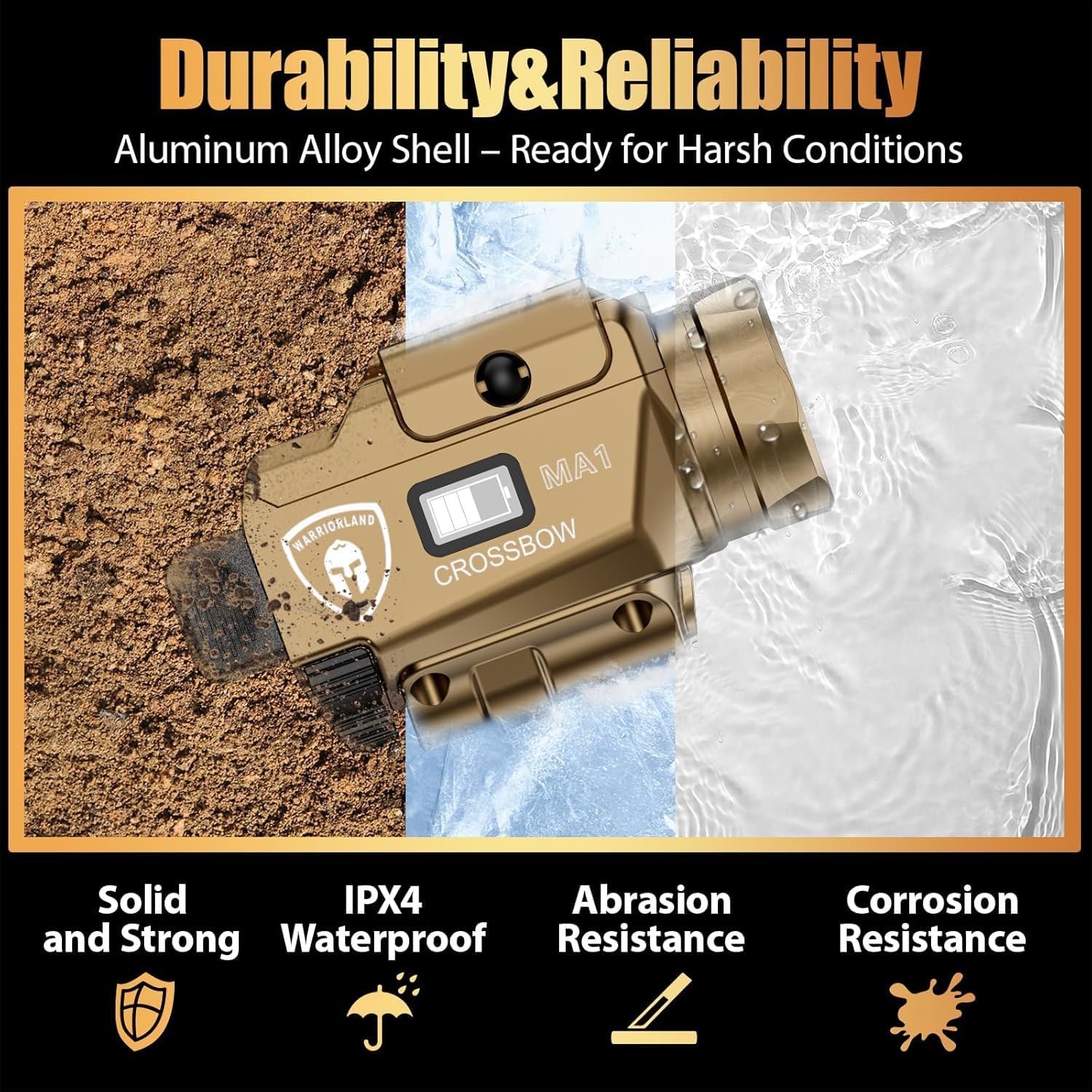
- MA1 Light/Laser Combo with SIG P320 Compact/M18/Full-Size/M17 Holster — 800-lumen green laser and LED tactical light with platform-specific holster. Magnetic USB recharging, screen battery display.
- SIG P320 M18 & M17 IWB/OWB Convertible Holster — Optics Cut — Convertible IWB/OWB Kydex holster for P320 M18 and M17. Optics cut, 1.75" belt clip, adjustable ride height. The versatile carry solution for P320 platform carriers who want both carry modes.
- 500-Lumen Tactical Light with P320 M18 Holster Combo — Compact rail-mounted pistol weapon flashlight with power indicator and three light modes, paired with a P320 M18 holster.
The Micro-Compact Revolution: The P365 (2018)
Redefining What a Carry Pistol Could Be
If the P320 defined SIG SAUER's duty and full-size market position, the P365 — introduced in 2018 — redefined the concealed carry market entirely. The P365 achieved something that had been considered impossible: a micro-compact pistol with a 10-round flush-fit magazine capacity in a package smaller than most single-stack 9mm pistols of the era.
The P365 accomplished this through a patented double-stack magazine design that achieved 10-round capacity in a width comparable to single-stack alternatives. The result was a pistol that offered full-size magazine capacity in a package small enough for comfortable all-day concealed carry — a combination that had not previously existed in the market.
The P365 was named the American Rifleman's Pistol of the Year for 2019 and became one of the best-selling pistols in the United States within its first year of availability. It spawned a family of variants — the P365 XL (longer slide and grip), the P365 X (longer grip, shorter slide), and the P365 XMACRO (full-size capacity in a compact package) — that collectively dominate the micro-compact carry market.
WARRIORLAND's P365 family carry solutions:
- Pistol Light/Laser with IWB Holster — SIG P365/P365X/P365XL — 150-lumen trigger-mounted tactical weapon light with green laser and IWB holster. Complete light-equipped carry solution for P365/P365X/P365XL carriers.
- Pistol Light/Laser with IWB Holster — SIG P365-XMACRO (Red Laser) — 150-lumen trigger-mounted tactical weapon light with red laser and IWB holster for P365-XMACRO carriers.
- Pistol Light/Laser with IWB Holster — SIG P365-XMACRO (Green Laser) — 150-lumen trigger-mounted tactical weapon light with green laser and IWB holster for P365-XMACRO carriers.
- IWB Kydex Holster for SIG P365-XMACRO with TLR-7X Sub or TLR-7 HL-X Sub — Light-bearing IWB holster for the P365-XMACRO with Streamlight TLR-7 sub-compact lights. Optics cut, adjustable cant and posi-click retention.
- SIG P365X-MACRO IWB Kydex Holster with Claw Attachment and Optic Cut — Inside-waistband appendix carry holster for the P365 X Macro. Adjustable cant and retention, right-hand draw.
Beyond Pistols: SIG SAUER's Broader Product Evolution
Rifles: The MCX and the Special Operations Market
SIG SAUER's product evolution extended well beyond pistols. The MCX rifle platform, introduced in 2015, was developed in response to U.S. Special Operations Command requirements for a suppressor-optimized, multi-caliber rifle system. The MCX's short-stroke piston operating system — unlike the direct impingement system used in standard AR-15/M16 platforms — runs cleaner and cooler, particularly important for suppressed operation.
The MCX Spear, chambered in 6.8x51mm Common Cartridge, was selected by the U.S. Army as the XM5 rifle in 2022 as part of the Next Generation Squad Weapon program — the first new U.S. military rifle since the M16 was adopted in the 1960s. This selection, combined with the M17/M18 pistol contract, made SIG SAUER the supplier of both the U.S. military's standard rifle and standard pistol simultaneously — an extraordinary achievement.
Suppressors, Optics, and Ammunition
SIG SAUER's evolution into a full-spectrum defense and sporting company extended to suppressors (SIG SAUER Suppressors), optics (the ROMEO and JULIET series of red dot sights and magnifiers), and ammunition (SIG SAUER Elite Performance Ammunition). This vertical integration — producing the firearm, the optic, the suppressor, and the ammunition — reflects a strategic vision of providing complete weapons systems rather than individual components.
The ROMEO series of red dot sights, in particular, has achieved significant market penetration in both the civilian and law enforcement markets, offering quality optics at competitive price points. The integration of SIG optics with SIG pistols — particularly the P320 with its optics-ready slide options — creates a coherent system that appeals to buyers who want matched components from a single manufacturer.
The Legion Series: Premium Performance for Discerning Shooters
In 2015, SIG SAUER introduced the Legion series — premium versions of its most popular pistols with enhanced triggers, improved ergonomics, and exclusive finishes. The Legion P226, P229, and P320 variants offered factory-tuned triggers, G10 grip panels, and a proprietary gray finish that distinguished them from standard production models.
The Legion series represented SIG SAUER's acknowledgment that a significant segment of its customer base wanted more than a reliable service pistol — they wanted a refined shooting instrument. The Legion trigger improvements, in particular, addressed the one area where SIG's DA/SA pistols had always faced criticism: the transition from the long double-action first pull to the shorter single-action subsequent pulls.
SIG SAUER Today: From Neuhausen to Newington
A Global Defense and Sporting Company
Today, SIG SAUER operates manufacturing facilities in Newington, New Hampshire; Exeter, New Hampshire; and Eckernförde, Germany, employing thousands of people across its global operations. The company produces pistols, rifles, suppressors, optics, and ammunition for military, law enforcement, and civilian markets in more than 100 countries.
The transformation from a Swiss wagon factory to a global defense and sporting company took 170 years and required a series of pivotal decisions: the government rifle contract that started it all, the partnership with Sauer that enabled global expansion, the P226's performance in the U.S. military competition that established the brand's American reputation, the P320's MHS victory that validated the modular concept, and the P365's redefinition of what a carry pistol could be.
What Makes SIG SAUER Different
Throughout its evolution, SIG SAUER has maintained a consistent identity: precision manufacturing, institutional reliability, and continuous innovation. These aren't marketing claims — they're the product of 170 years of building weapons that governments and military forces trust with their personnel's lives.
The company's willingness to invest in genuinely new designs — the P210's slide-inside-frame, the P220's decocking system, the P320's modular FCU, the P365's high-capacity micro-compact format — rather than iterating on existing platforms reflects an engineering culture that prioritizes performance over cost reduction. This culture produces pistols that cost more than many alternatives but deliver a level of fit, finish, and reliability that justifies the premium for buyers who understand what they're getting.
Carrying a SIG SAUER: The Complete System
A SIG SAUER pistol is the foundation of a defensive carry system — but the system isn't complete without a weapon light for low-light identification and a holster designed for the specific pistol-plus-light combination. WARRIORLAND's SIG-compatible lineup provides the carry infrastructure for the most popular SIG platforms:
For P320 platform carriers (M17/M18/Compact/Full-Size):
- SIG P320 Kydex Holster with MA1 800-Lumen Light/Laser — Complete light-equipped IWB carry solution
- MA1 Light/Laser Combo with P320 M18/M17 Holster — 800-lumen green laser and LED with platform-specific holster
- P320 M18/M17 IWB/OWB Convertible Holster — Optics cut, adjustable ride height, dual carry mode
For P365 family carriers (P365/P365X/P365XL/P365-XMACRO):
- P365/P365X/P365XL Light/Laser with IWB Holster — 150-lumen trigger-mounted light and green laser
- P365-XMACRO Light/Laser with IWB Holster (Green Laser) — Complete light-equipped carry solution for XMACRO carriers
- P365-XMACRO IWB Light-Bearing Holster — TLR-7X Sub/TLR-7 HL-X Sub — Optics cut, posi-click retention, adjustable cant
- P365X-MACRO IWB Kydex Holster with Claw and Optic Cut — Appendix carry optimized, adjustable retention
Universal weapon light compatible with SIG rail-equipped pistols:
- WARRIORLAND MA2 — Universal 800-Lumen Rail-Mounted Pistol Light, Fits 60+ Handguns — Compatible with P365 and other SIG rail-equipped platforms. Screen power indicator, magnetic USB recharging.
Conclusion: 170 Years of Getting It Right
SIG SAUER's history is a study in how institutional commitment to quality compounds over time. The precision manufacturing culture that Friedrich Peyer im Hof brought to wagon production in 1853 is the same culture that produced the P210's extraordinary accuracy, the P226's legendary reliability, the P320's modular innovation, and the P365's market-redefining capacity.
The company has never been the cheapest option in any market it has entered. It has consistently been among the best — and the military contracts, law enforcement adoptions, and civilian sales that have followed reflect buyers' willingness to pay for that quality.
For carriers who choose SIG SAUER, the pistol is the beginning of the system. The weapon light, the holster, and the training that integrates them complete it. WARRIORLAND's SIG-compatible carry solutions — from the P320 light-equipped holster combo to the P365 family light/laser solutions — provide the carry infrastructure that SIG SAUER's engineering deserves. Build the complete system. Carry with confidence.